




What's Happening?
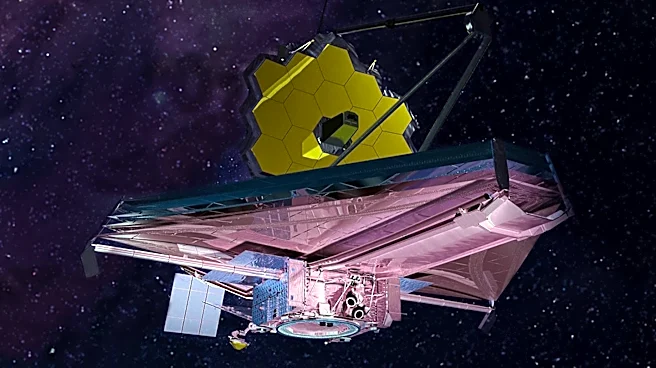
New research, led by Sunmyon Chon of the Max Planck Institute for Astrophysics, suggests that the mysterious 'Little Red Dots' observed by the James Webb Space Telescope (JWST) in the early universe may actually be supermassive black holes that are rapidly
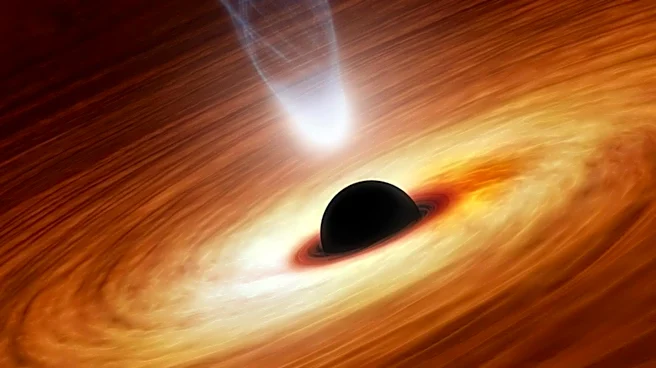
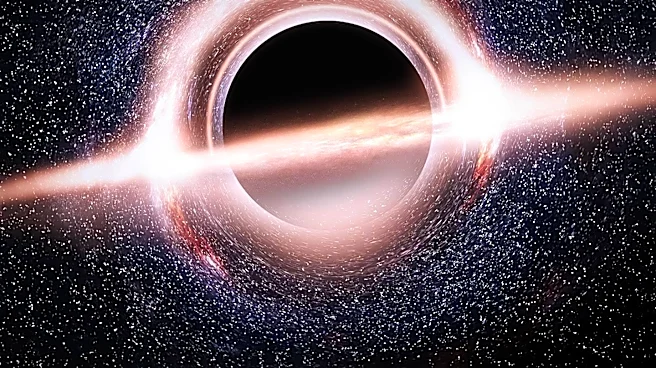
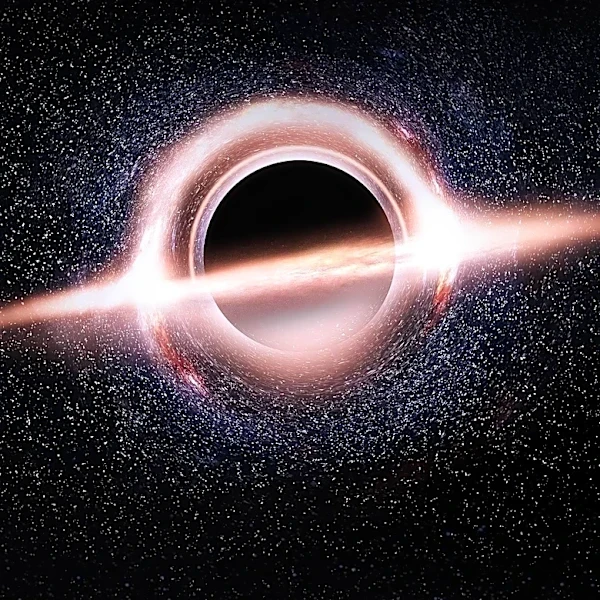
'overfeeding.' These simulations indicate that both the Little Red Dots and the presence of supermassive black holes in the early universe emerge naturally under the conditions found shortly after the Big Bang. The team found that when black holes are supplied with gas at an extremely high rate, the gas accumulates around them, forming a dense, optically thick envelope. This envelope, through which electromagnetic radiation must pass, changes the wavelengths of the radiation, resulting in the compact, very red spectrum and broad hydrogen emission lines characteristic of Little Red Dots. This 'overfeeding' mechanism could explain how black holes grew to billions of times the mass of the sun before they should have had time to do so through ordinary feeding or mergers.
Why It's Important?
This research is important because it offers a potential solution to two significant puzzles presented by the James Webb Space Telescope's observations: the existence of surprisingly massive black holes in the early universe and the nature of the enigmatic 'Little Red Dots.' Understanding how supermassive black holes formed and grew so rapidly in the universe's infancy is crucial for comprehending galaxy evolution and the structure of the cosmos. If Little Red Dots are indeed overfeeding black holes, it provides a direct observational link to these early growth phases. This discovery could refine cosmological models and our understanding of the conditions prevalent in the early universe, such as the abundant supply of gas and the role of radiation from nearby star-forming galaxies. It also highlights the power of cosmological simulations to interpret complex astronomical data and connect seemingly disparate phenomena.
What's Next?
The research team plans to further investigate if the formation of overmassive black holes and Little Red Dots occurs in their simulations when environmental conditions of the early universe are varied. They also intend to make more detailed predictions that can be directly compared to ongoing observations from the James Webb Space Telescope. While the simulations explain the origin of Little Red Dots, they do not yet clarify why these objects seem to disappear at later cosmic times, which remains an open question for future research. The team emphasizes the need for theorists to keep pace with the rapid advancements in observational data from the JWST to effectively use these new observations to determine the true nature of these remarkable objects and their role in cosmic history.
Beyond the Headlines
The connection between 'Little Red Dots' and overfeeding black holes delves into the profound implications of the universe's earliest moments. It suggests that the conditions in the young cosmos were uniquely conducive to extreme phenomena, such as the rapid growth of black holes, which are not commonly observed today. This research challenges our assumptions about the typical life cycle of black holes and the mechanisms of cosmic evolution. The concept of a 'quasi-star' — a black hole embedded in a massive, optically thick gaseous envelope — emerging naturally from simulations, opens up new theoretical possibilities for understanding exotic objects in the universe. It underscores the dynamic and often violent nature of the early universe, where processes unfolded on scales and at rates far exceeding those in the present day, fundamentally shaping the galaxies and structures we observe today.