







What's Happening?
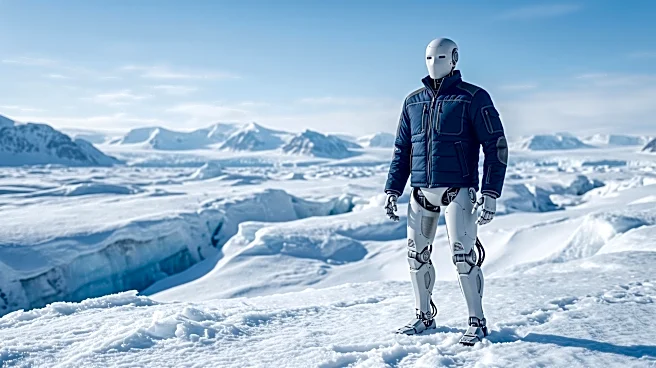
A humanoid robot named Qestr attempted to run a marathon in Antarctica but was unable to complete the race, giving up after only 3 kilometers. Qestr, equipped with a specially designed thermal jacket, joined 25 human runners in the Antarctic Ice Ultra
near Ultima Camp on November 8, 2026. The primary reason for its failure was battery depletion. The extreme cold, with temperatures around minus 24 degrees Celsius, significantly impacted the robot's lithium-ion batteries. Low temperatures slow down the chemical reactions within these batteries, making it difficult for them to release energy efficiently and causing them to drain much faster than in milder conditions. Despite the thermal jacket intended to keep its components warm, it proved insufficient to protect the battery from the freezing Antarctic environment, which is crucial for sustained physical exertion.
Why It's Important?
The failure of humanoid robot Qestr to complete an Antarctic marathon due to battery issues highlights a significant challenge in the development and deployment of robotics in extreme environments. For U.S. industries and research institutions involved in robotics, particularly those focused on exploration, defense, or disaster response in harsh conditions, this event underscores the critical need for advancements in battery technology and thermal management systems. The impact of extreme cold on lithium-ion batteries is a known limitation, but Qestr's experience demonstrates the practical difficulties in overcoming this for sustained, high-performance tasks. This incident could spur further research into alternative power sources, more robust battery designs, or innovative heating solutions for robotic components. It also emphasizes that while robots can perform complex tasks, their physical limitations, especially in challenging climates, remain a major hurdle for widespread adoption in certain applications.
What's Next?
The experience of Qestr in the Antarctic marathon will likely inform future research and development efforts in robotics. Engineers and scientists will focus on improving battery performance in extreme cold, potentially exploring new battery chemistries or advanced thermal insulation and heating systems. The design of future robots intended for polar or other harsh environments will need to incorporate more resilient power solutions. This incident may also lead to the development of specialized robotic components that are less susceptible to temperature fluctuations. Furthermore, it could encourage a re-evaluation of the types of tasks robots are assigned in extreme conditions, perhaps favoring shorter missions or those with more frequent recharging opportunities. The broader robotics community, including U.S. researchers, will likely analyze Qestr's performance to identify key areas for technological advancement.
Beyond the Headlines
Qestr's attempt and subsequent failure in the Antarctic marathon offer a poignant illustration of the current boundaries of robotic endurance and autonomy, particularly when confronted with the unforgiving forces of nature. Beyond the technical challenge of battery life, this event touches upon the philosophical question of human versus machine capabilities in extreme environments. While humans can adapt and endure through sheer will and biological mechanisms, robots are bound by their physical and energy limitations. This highlights that despite rapid advancements in AI and robotics, there are still fundamental differences in how biological and artificial systems interact with and survive in the world. The narrative of a robot 'giving up' after 3 km also subtly anthropomorphizes the machine, inviting reflection on our expectations of artificial intelligence and its potential to mimic or surpass human capabilities in all contexts. It serves as a reminder that the 'robot revolution' still faces significant engineering hurdles, especially when venturing beyond controlled environments.