








What's Happening?
Researchers from Cairo University and the Technical University of Munich have discovered two concealed air-filled anomalies inside the Menkaure pyramid, the third-largest pyramid at Giza. These findings, part of the ScanPyramids project, suggest the possibility
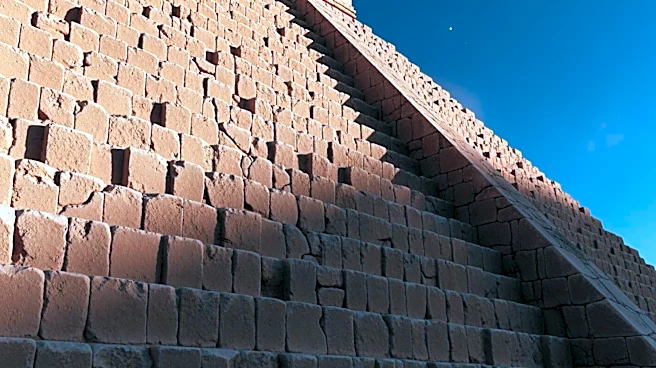
of an undiscovered entrance on the eastern side of the pyramid. Using advanced techniques such as radar, ultrasound, and electrical resistivity tomography, the team identified two voids behind the eastern facade, which has long puzzled researchers due to its unusually smooth and polished granite blocks. The voids, located at depths of 1.4 meters and 1.13 meters, provide the first solid evidence supporting the hypothesis of a second entrance.
Why It's Important?
The discovery of hidden voids in the Menkaure pyramid represents a significant advancement in the field of archaeology and Egyptology. It offers new insights into the construction and design of ancient Egyptian pyramids, potentially revealing previously unknown aspects of their architectural and cultural significance. The use of non-invasive scanning techniques also highlights the importance of preserving historical structures while advancing scientific understanding. This finding could lead to further exploration and research, enhancing our knowledge of ancient civilizations and their engineering capabilities. The potential discovery of a secret entrance could attract global attention and increase interest in Egypt's rich archaeological heritage.