








What's Happening?
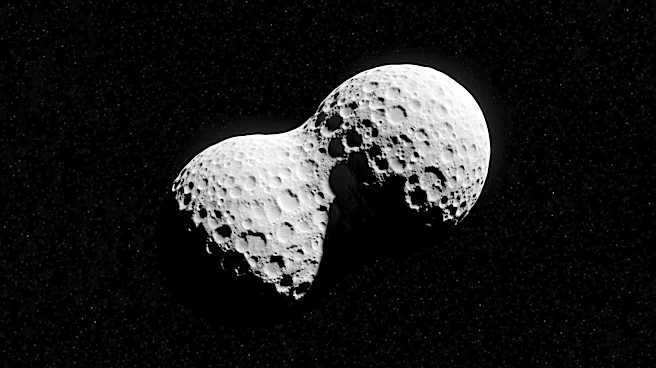
NASA's Lucy spacecraft has provided new insights into the asteroid Donaldjohanson, revealing it to be a wobbling, peanut-shaped body. During a flyby on April 20, 2025, Lucy captured high-resolution images and data, showing the asteroid's unique two-axis
rotation and its bilobate structure. This asteroid, formed from fragments after a collision 155 million years ago, exhibits signs of past liquid water exposure. The mission, which serves as a precursor to Lucy's primary encounters with Jupiter's Trojan asteroids, has allowed scientists to compare Donaldjohanson with other asteroids like Bennu and Ryugu, enhancing understanding of asteroid dynamics and solar system history.
Why It's Important?
The discovery of Donaldjohanson's unique characteristics provides valuable data for understanding asteroid formation and evolution. The asteroid's complex rotation and shape offer insights into the effects of solar radiation and collision history on small celestial bodies. This information is crucial for future missions and for understanding the early solar system's conditions. The presence of iron-rich clays suggests brief water exposure, offering clues about the asteroid's past environment. These findings contribute to broader scientific efforts to trace the origins and development of the solar system, potentially impacting future space exploration strategies.
What's Next?
NASA's Lucy mission will continue its journey towards the Trojan asteroids, with the next major encounter scheduled for August 12, 2027, when it will fly by the Trojan asteroid Eurybates. The mission aims to gather more data on these ancient bodies, which are believed to hold keys to understanding the solar system's formation. The scientific community anticipates that further analysis of the data collected from Donaldjohanson and future encounters will refine models of asteroid behavior and solar system dynamics, potentially influencing future asteroid exploration missions.
Beyond the Headlines
The Lucy mission's findings on Donaldjohanson highlight the intricate dynamics of small celestial bodies and the subtle forces shaping them. The asteroid's wobbling motion, influenced by the YORP effect, underscores the complex interplay between solar radiation and asteroid rotation. This discovery may prompt a reevaluation of how these forces impact other asteroids, potentially affecting planetary defense strategies. Additionally, the mission's success in capturing detailed data from a relatively unexplored asteroid sets a precedent for future missions, emphasizing the importance of technological advancements in space exploration.