






What's Happening?
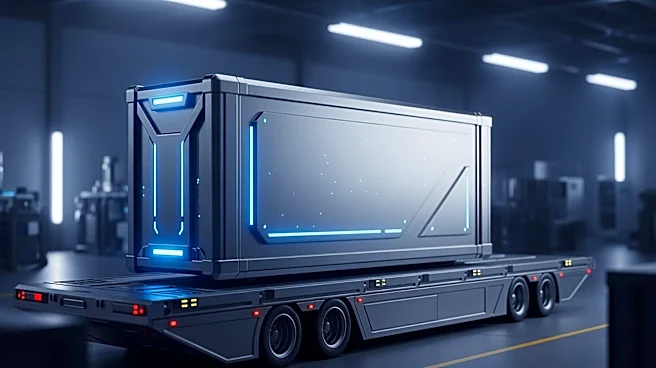
CERN has successfully transported antimatter by truck for the first time, marking a significant milestone in physics research. The antimatter, specifically 92 antiprotons, was moved around CERN's facility on the France-Switzerland border. This material,
produced by CERN's particle accelerator, is stored and shipped for further study. Antimatter is the opposite of regular matter, with antiprotons being negatively charged counterparts to protons. The transportation of antimatter is crucial for studying its properties without interference from CERN's powerful magnets. This development could help address fundamental questions about the universe, such as why there is more matter than antimatter.
Why It's Important?
The ability to transport antimatter safely is a breakthrough that could significantly enhance our understanding of the universe. Antimatter holds the potential to unlock mysteries dating back to the Big Bang, including the imbalance between matter and antimatter. This research could lead to new insights into the fundamental laws of physics. The successful transportation of antimatter also demonstrates advancements in handling and studying this volatile material, which could have future applications in energy production and other scientific fields. The implications of this research extend beyond academia, potentially influencing technology and industry.
What's Next?
Following this successful transportation, further studies on antimatter are expected to continue, focusing on precise measurements of its properties. Researchers aim to identify any discrepancies between matter and antimatter that could provide answers to longstanding scientific questions. The ongoing research at CERN will likely involve collaboration with other scientific institutions to expand the scope of study. As the understanding of antimatter improves, it may lead to new technological innovations and applications, although practical uses remain speculative at this stage.
Beyond the Headlines
The transportation of antimatter by truck highlights the logistical and technical challenges involved in handling such a volatile substance. This achievement underscores the importance of international collaboration in scientific research, as CERN's work involves contributions from scientists worldwide. The ethical considerations of antimatter research, particularly its potential use in energy and weaponry, will likely be a topic of discussion as the field progresses. The study of antimatter also reflects humanity's enduring quest to understand the universe, pushing the boundaries of what is scientifically possible.