







What's Happening?
Across Europe, ancient legends recount tales of dragons and their encounters with heroes. In Orkney, Scotland, the Mester Stoor Worm, a colossal water dragon believed to be Loki's child, terrorized the land, demanding daily feasts of cattle, villagers,
and castles. The King offered his kingdom and the sword Sikkersnapper, a weapon of Odin, to anyone who could defeat it. Many warriors failed until a boy named Assipattle tricked the beast by throwing a smoldering clod of peat into its mouth, causing it to retch and ultimately die, forming the Orkney, Shetland, and Faroe Isles from its teeth and Iceland from its body. In Germany, the legend of Fafnir, a dwarf cursed by a gold ring, transformed into a venomous dragon guarding treasure. Prince Siegfried eventually slayed Fafnir by hiding in a trench and thrusting his sword into its belly. A splash of Fafnir's blood hardened Siegfried's skin, making him invincible except for a spot where a leaf fell. In Terni, Italy, the wyvern Thyrus terrorized the city with its stench and appetite. A young knight from the Cittadini family, whose name is lost to time, blinded Thyrus with his armor's reflection and then slayed the beast, freeing the city. Thyrus is now part of Terni's coat of arms, and its stone body stands in the Palazzo Spada courtyard.
Why It's Important?
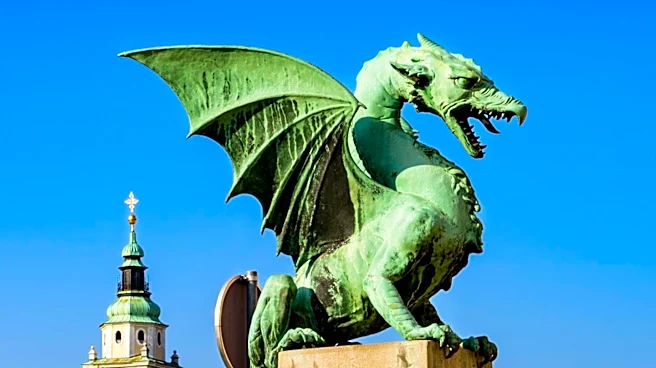
These European dragon legends are important as they offer a glimpse into the cultural and historical narratives that shaped early societies. They reflect common human themes such as heroism, the struggle against overwhelming evil, and the triumph of wit and courage over brute force. These stories often served as moral lessons, reinforcing community values and providing explanations for natural phenomena or geographical formations, as seen with the Mester Stoor Worm creating islands. The legends also highlight the evolution of mythical creatures, with early European dragons often depicted as legless, wingless, snake-like monsters, contrasting with the more modern, four-legged, winged portrayals. The enduring presence of these dragons in city symbols, like Thyrus in Terni's coat of arms, demonstrates their lasting impact on regional identity and heritage, connecting contemporary communities to their ancient past through shared folklore and symbolic representations.
What's Next?
While these are ancient legends, their influence continues to be seen in modern culture through various forms of media, including books, movies, and video games. The ongoing retelling and reinterpretation of these myths ensure their survival and relevance for new generations. For instance, the detailed descriptions of different dragon types—such as Basilisks, Drakes, Drakons, Lindwurms, and Wyverns—provide a rich source of inspiration for fantasy writers and artists. Educational initiatives and cultural tourism in regions like Orkney, Drachenfels, and Terni may continue to highlight these legends, drawing visitors interested in folklore and history. Local communities might also organize events or exhibitions centered around these mythical figures, further embedding them into the public consciousness and preserving their cultural significance. The continuous engagement with these stories ensures that the heroic deeds and monstrous challenges they describe remain a vibrant part of European heritage.
Beyond the Headlines
Beyond their entertainment value, these dragon legends offer deeper insights into the human psyche and societal development. They often embody primal fears and anxieties, such as the fear of the unknown, natural disasters, or powerful adversaries. The heroes who confront these dragons frequently represent ideal human qualities like bravery, ingenuity, and self-sacrifice, serving as archetypes for moral and ethical conduct. The transformation of Fafnir from a dwarf to a dragon due to greed, for example, serves as a cautionary tale about the corrupting influence of wealth. The evolution of dragon depictions from simple 'worms' to complex winged beasts reflects changing cultural perceptions and storytelling sophistication over centuries. These myths also illustrate how different cultures interpret and integrate fantastical elements into their understanding of the world, providing a rich tapestry of shared human experience and imagination that transcends geographical boundaries and historical periods.