





What's Happening?
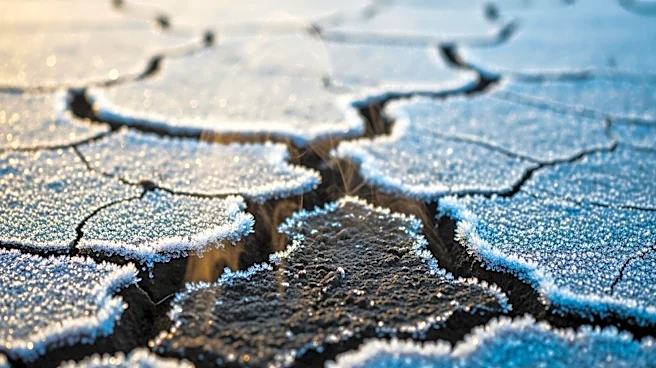
A study published in Nature Communications reveals that warming temperatures in the Tibetan Plateau are unlocking ancient carbon stored in permafrost, potentially accelerating climate change. The research, conducted by Professor Jinzhi Ding and her team
from the Institute of Tibetan Plateau Research, indicates that a temperature increase of 2-4 degrees Celsius could trigger a self-reinforcing cycle of carbon release. This process involves the thawing of permafrost, which allows microbes to decompose organic matter, releasing carbon dioxide into the atmosphere. The Tibetan Plateau, home to the world's largest alpine permafrost carbon reservoir, is warming at 2.5 times the global average rate. The study involved a five-year experiment using infrared heaters to simulate different warming scenarios, revealing that even moderate warming could lead to significant carbon losses.
Why It's Important?
The findings highlight a critical climate tipping point, where carbon losses from permafrost could outpace carbon gains, exacerbating global warming. This has significant implications for climate models, which may currently underestimate the impact of permafrost carbon feedback. The release of ancient carbon, previously locked in permafrost, represents a net addition to atmospheric carbon levels, potentially accelerating climate change. The study underscores the need for refined climate models that account for depth-resolved carbon dynamics and the mobilization of ancient carbon. As global temperatures continue to rise, understanding these processes is crucial for predicting and mitigating the impacts of climate change.
What's Next?
Future research is needed to refine the exact tipping-point temperature and integrate these findings into global climate models. The study's authors suggest that longer-term experiments and more detailed warming gradients could provide further insights. Additionally, understanding how plant and microbial communities might adapt to changing conditions could help predict future carbon dynamics. Policymakers and climate scientists may need to consider these findings in developing strategies to mitigate climate change and protect permafrost regions.