






What's Happening?
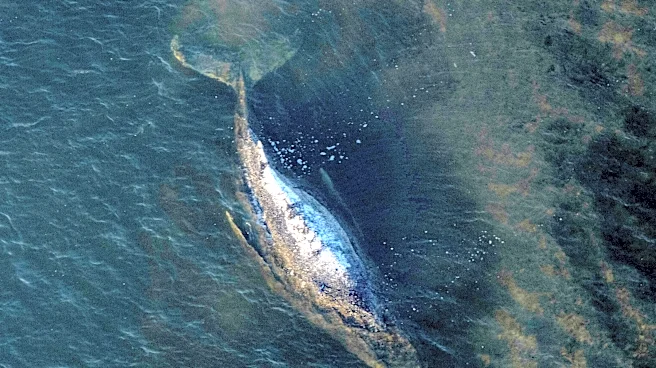
In a surprising turn of events, bones initially believed to be those of ancient mammoths found in Alaska have been identified as whale remains. The discovery, made by archaeologist Otto Geist in 1951, was long thought to be a significant find of woolly
mammoth fossils. However, recent radiocarbon dating and chemical analysis conducted by scientists at the University of Alaska Fairbanks revealed that the bones are only 2,000 to 3,000 years old, much younger than the 13,000-year-old mammoth extinction timeline. The bones, found 250 miles from the nearest coastline, were determined to belong to marine animals, likely a Northern Pacific right whale and a common minke whale, based on isotope signatures and mitochondrial DNA analysis.
Why It's Important?
This revelation challenges previous assumptions about the presence of mammoths in Alaska during the Late Holocene period. Had the bones been mammoth remains, it would have significantly altered the understanding of the species' timeline and distribution. The findings highlight the importance of scientific verification in paleontological studies and underscore the potential for misinterpretation of fossil records. The discovery also raises questions about how whale bones ended up so far inland, suggesting possible ancient human activity or natural transport mechanisms, which could provide new insights into historical ecological and human migration patterns.
What's Next?
Researchers are exploring several theories to explain the inland location of the whale bones, including ancient human transport or natural river routes. However, no definitive explanation has been confirmed. The study emphasizes the need for further investigation into the movement of marine remains in prehistoric times. Additionally, the possibility of a museum mix-up during the 1950s, when Geist collected and donated numerous specimens, remains a consideration. Future research may focus on verifying the origins of other similar finds to prevent misclassification and enhance the accuracy of historical records.