






What's Happening?
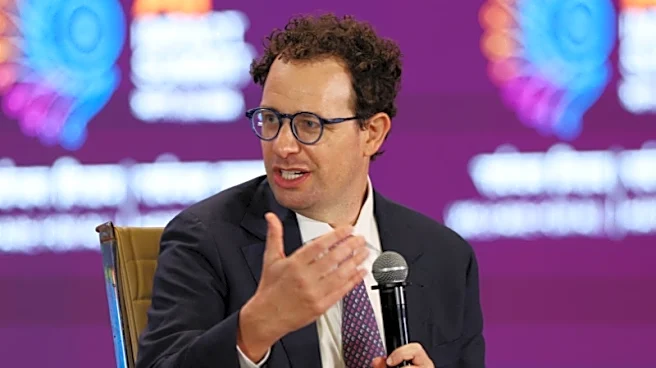
Alex Karp, CEO of Palantir, has stated that an artificial intelligence (AI) framework between the United States and China would be transformative globally. Speaking on 'Squawk on the Street,' Karp discussed the concerns surrounding AI safety and the objectives
of AI CEOs. His comments underscore the growing recognition among technology leaders of the need for international cooperation in managing the development and deployment of advanced AI. The discussion highlights the dual nature of AI as both a powerful tool for progress and a potential source of significant risks, emphasizing the importance of establishing clear guidelines and agreements between major global powers to ensure responsible AI development.
Why It's Important?
Karp's call for a U.S.-China AI framework is highly significant for U.S. politics, national security, and the global technology landscape. Such a framework could mitigate the risks of an unbridled AI arms race between the two technological superpowers, potentially preventing destabilizing developments and fostering a more secure international environment. For U.S. industries, a cooperative framework could lead to shared standards for AI safety and ethics, reducing regulatory fragmentation and facilitating cross-border collaboration on beneficial AI applications. Conversely, a lack of such an agreement could intensify competition, leading to divergent technological paths and increased geopolitical tensions. The U.S. government and policymakers would need to navigate complex diplomatic challenges to establish common ground with China on sensitive AI issues, balancing national interests with the imperative for global stability in this rapidly evolving field.
What's Next?
The suggestion of a U.S.-China AI framework is a high-level proposal that would require extensive diplomatic efforts and political will from both nations. While Karp's statement highlights the urgency, concrete steps towards such a framework are not immediately apparent. Future developments would likely involve preliminary discussions between U.S. and Chinese officials, potentially through existing diplomatic channels or newly established working groups focused on AI governance. Key stakeholders, including technology companies, academic experts, and international organizations, would likely contribute to shaping the agenda and technical details of any potential agreement. The success of such an initiative would depend on overcoming significant geopolitical differences and building mutual trust, which remains a considerable challenge given current international relations.
Beyond the Headlines
Beyond the immediate political and economic implications, a U.S.-China AI framework touches upon profound ethical and philosophical questions regarding the future of humanity and technology. The development of advanced AI, particularly in areas like autonomous weapons systems or widespread surveillance, raises concerns about human control, privacy, and fundamental rights. A cooperative framework could establish shared ethical principles, such as transparency, accountability, and human oversight, guiding the responsible development of AI. Conversely, a competitive approach could lead to a 'race to the bottom' where ethical considerations are sidelined in pursuit of technological dominance. The long-term societal impact of AI, including its potential to reshape labor markets, influence democratic processes, and redefine human capabilities, necessitates a global dialogue that transcends national interests and focuses on the collective well-being of humanity.