




What's Happening?
NASA's Psyche spacecraft successfully completed a close encounter with Mars on May 15, 2026, capturing detailed images of the planet's surface. The flyby, which brought the spacecraft within 2,900 miles of Mars, was part of a gravity assist maneuver designed
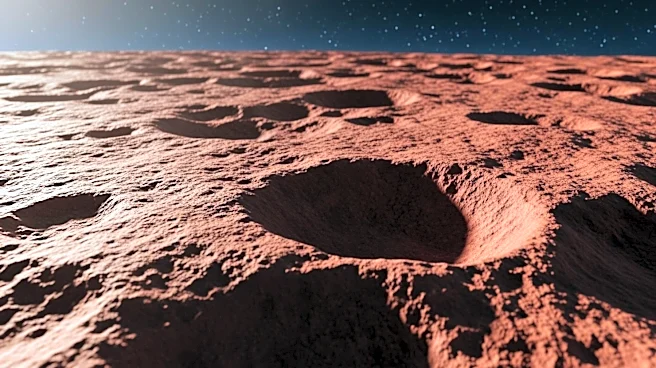
to increase Psyche's velocity by approximately 1,000 mph. This maneuver is crucial for redirecting the spacecraft towards its ultimate destination, the asteroid 16 Psyche. During the flyby, mission controllers utilized the opportunity to photograph Mars from unique angles, revealing its polar ice caps, wind-carved surface features, and crater formations. The images serve not only as a visual record but also as a means to test and calibrate the spacecraft's scientific instruments before it reaches the asteroid in 2029.
Why It's Important?
The successful flyby of Mars by NASA's Psyche spacecraft is a significant milestone in space exploration, as it provides critical data and testing opportunities for the mission's scientific instruments. The images captured during the flyby offer valuable insights into Martian geology and atmospheric conditions, which can enhance our understanding of the planet. Furthermore, the mission's ultimate goal of reaching the asteroid 16 Psyche could yield unprecedented information about the formation of rocky planets, including Earth. By studying what is believed to be the exposed metallic core of an ancient planetary body, scientists hope to gain insights into the processes that formed Earth's iron core, potentially revolutionizing our understanding of planetary formation.
What's Next?
Following the successful Mars flyby, NASA's Psyche spacecraft will continue its journey towards the asteroid 16 Psyche, with an expected arrival in the summer of 2029. Once there, the spacecraft will spend several years mapping the asteroid's composition and structure. If the asteroid is confirmed to be a planetary core fragment, it could provide a unique window into the deep interiors of terrestrial worlds. The mission's findings could have far-reaching implications for planetary science and our understanding of the solar system's history.