










What's Happening?
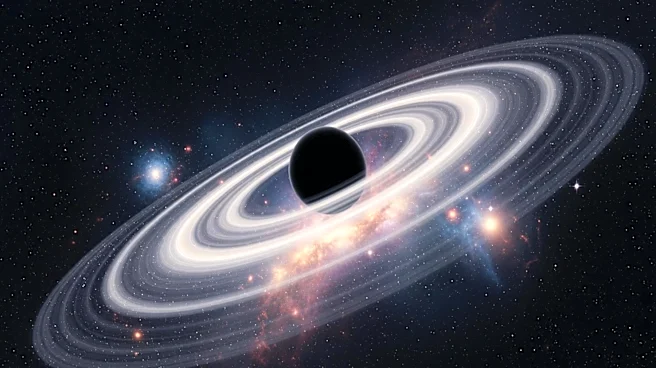
Researchers at the University of Colorado Boulder, in collaboration with Wladimir Lyra from New Mexico State University, have developed a computer model suggesting that supermassive black holes could be prolific planet factories. The study indicates that the accretion
discs surrounding these black holes, which are composed of gas and dust, might facilitate the formation of millions of planets. This phenomenon, known as 'streaming instability,' allows large filaments of dust to clump together, potentially forming planets with masses exceeding that of Jupiter. The research highlights that these conditions are more favorable in active galactic nuclei (AGN) discs compared to the planetary discs around young stars, due to the higher levels of gas present.
Why It's Important?
This discovery could significantly alter our understanding of planet formation and the role of supermassive black holes in the universe. If confirmed, it suggests that black holes are not just destructive forces but also creators of new worlds. This could have profound implications for the study of galaxy formation and evolution, as well as the potential for life in the universe. The findings challenge existing theories about planet formation, which have traditionally focused on stars rather than black holes as the primary sites for planet creation.
What's Next?
Further research is needed to validate these findings and explore the implications for our understanding of the universe. Scientists may focus on observing AGN discs to gather more data and refine their models. This could involve using advanced telescopes and other observational tools to detect the presence of planets forming in these extreme environments. The study opens new avenues for research into the conditions that allow for planet formation and the potential for life in regions previously thought to be inhospitable.