



What's Happening?
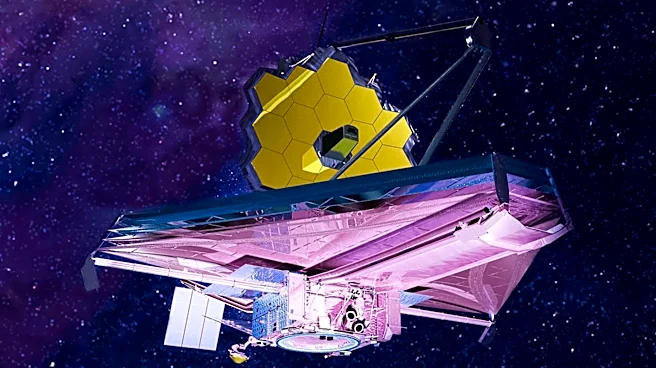
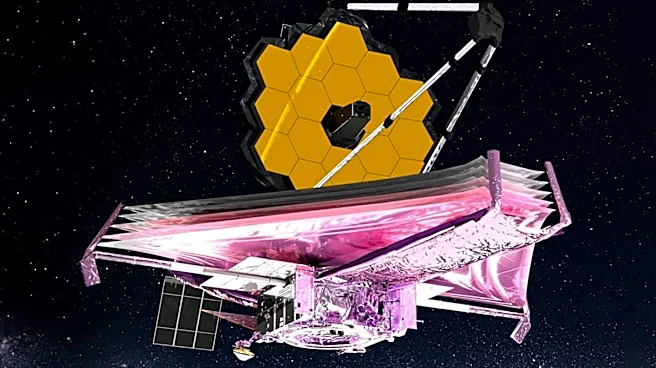
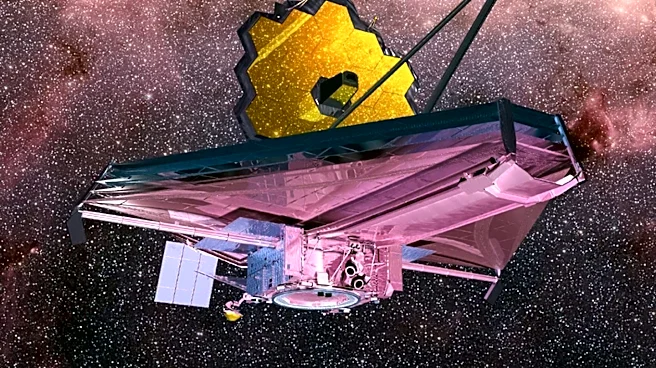
Astronomers have discovered a pair of supermassive black holes, known as LID-1166, using the James Webb Space Telescope (JWST) and the Atacama Large Millimeter/submillimeter Array (ALMA). These black holes are located in a merging galaxy and are separated
by only 4,900 light-years, making them the closest pair observed in the early universe, approximately 1.3 billion years after the Big Bang. This discovery provides a unique opportunity to study the growth of supermassive black holes and their role in galaxy formation. The black holes were initially detected as an X-ray source in the Chandra COSMOS Legacy Survey, and further analysis with JWST's Near-Infrared Spectograph confirmed their presence.
Why It's Important?
The discovery of LID-1166 is significant as it challenges existing models of black hole and galaxy formation. It suggests that supermassive black holes can form and grow rapidly in the early universe, potentially without the need for surrounding galaxies. This finding could reshape our understanding of how galaxies and their central black holes evolve over time. The ability to observe such systems provides astronomers with critical data to refine theoretical models and improve predictions about the universe's early development.
What's Next?
Future research will focus on studying similar systems to understand the mechanisms driving the rapid growth of supermassive black holes. Astronomers aim to uncover more hidden populations of black holes and explore their interactions within merging galaxies. Continued observations with advanced telescopes like JWST and ALMA will be crucial in providing deeper insights into these cosmic phenomena.