






What's Happening?
Recent studies have provided unprecedented insights into the daily lives and tool-making practices of Denisovans, an enigmatic ancient human population. Researchers extracted proteins from five human fossils found in a cave in southwestern China, confirming
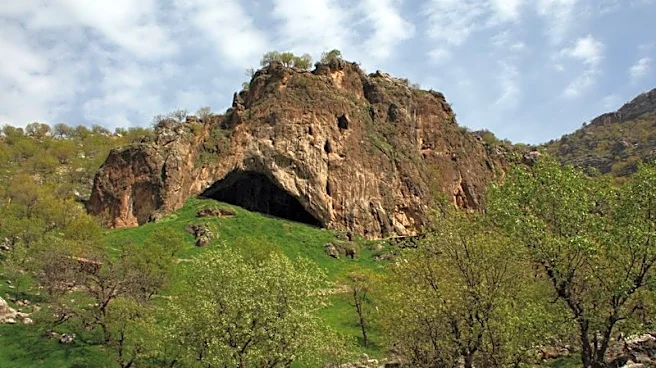
their Denisovan origin. This discovery is significant because previous knowledge of Denisovans was primarily based on DNA and a limited number of bone fragments. Alongside the human remains, scientists also examined stone tools and animal bones, marking the first time tools definitively linked to Denisovans have been identified. The cave, located in an area where a reforestation project led to its discovery, contained over 60,000 fossils and fragments, with the human bone layers dated between approximately 134,000 and 167,000 years ago. The findings reveal that Denisovans utilized locally available stone and bone to create tools, demonstrating an efficient and pragmatic approach to technology, often modifying materials minimally to suit their purpose. This contrasts with the more elaborate tool-making techniques observed in their Neanderthal relatives.
Why It's Important?
This breakthrough is crucial for understanding human evolution and the diversity of ancient hominin cultures. For years, Denisovans were largely considered a 'molecular ghost,' known primarily through genetic sequences and a few isolated bone fragments. The identification of their tools and the context of their daily lives transforms our perception of this ancient group, allowing us to see them as active participants in their environment rather than just genetic data. The discovery of their tool-making methods, characterized by efficiency and minimal modification, provides valuable comparative data for understanding the cognitive and technological capabilities of different hominin species. It also sheds light on their adaptation strategies and resource utilization in East Asia. Furthermore, the study of associated animal bones indicates that Denisovans were effective hunters of medium-sized and large hoofed animals, suggesting a stable and successful subsistence strategy over tens of thousands of years. This comprehensive view helps to fill significant gaps in the archaeological record of early human populations in Asia.
What's Next?
Future research will likely focus on further analyzing the vast collection of fossils and artifacts from the Chinese cave to gain deeper insights into Denisovan behavior, diet, and social structures. The identification of Denisovan tools opens new avenues for re-examining previously unassigned archaeological finds in Asia, potentially leading to the discovery of more Denisovan sites and artifacts. Scientists may also explore the environmental conditions of the region during the Denisovan occupation to understand how climate and landscape influenced their survival and cultural development. Continued protein analysis on other ancient human remains could help identify more Denisovan fossils, especially in regions where DNA preservation is challenging due to warm climates. The comparison of Denisovan tools with those of Neanderthals and early modern humans will also be a key area of study, aiming to refine our understanding of technological convergence and divergence among different hominin groups.
Beyond the Headlines
The shift from viewing Denisovans as merely genetic data to understanding their material culture has profound implications for paleoanthropology. It underscores the importance of interdisciplinary approaches, combining genetics, archaeology, and protein analysis, to reconstruct the lives of extinct human species. The pragmatic and efficient tool-making strategy of Denisovans challenges the notion that more complex or aesthetically refined tools are always indicative of superior intelligence or adaptability. Instead, it suggests that different hominin groups developed diverse and equally effective strategies for interacting with their environment. This discovery also highlights the vast unknown aspects of human history, particularly in regions like East Asia, which are increasingly yielding critical evidence for understanding the complex tapestry of human evolution. The ongoing discoveries related to Denisovans continue to reshape our understanding of the relationships and interactions between various ancient human populations, including their potential interbreeding with modern humans and Neanderthals.