




What's Happening?
The Dead Sea, the lowest point on Earth, is receding at an alarming rate of approximately four feet per year, leading to a one-third reduction in its surface area over the past five decades. This decline is primarily attributed to a combination of factors:
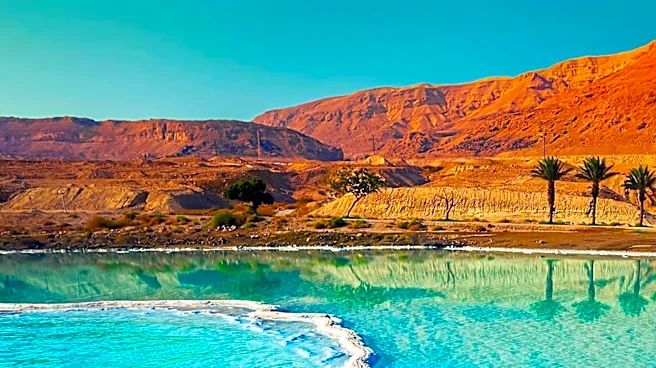
the significant diversion of water from the Jordan River for human consumption, agriculture, and livestock by Israel, Syria, and Jordan; extensive mineral extraction operations by companies like Dead Sea Works and Arab Potash Company, which pump water into evaporation pools; and increasingly severe and prolonged droughts exacerbated by climate change. The reduced water inflow and increased extraction have led to a dramatic decrease in the Jordan River's contribution to the Dead Sea, from 1.3 billion cubic meters to roughly 100 million cubic meters. As the water level drops, the concentration of salt has become so high that excess salt forms solid crystals that accumulate on the sea floor, resembling snow. The retreating shoreline has also resulted in the formation of over 6,000 sinkholes, posing significant threats to infrastructure, businesses, residents, and the natural landscape around the sea.
Why It's Important?
The continuous shrinkage of the Dead Sea carries profound environmental, economic, and social implications for the region. Environmentally, the formation of thousands of sinkholes destabilizes the land, making areas once accessible for tourism and development dangerous and unusable. This geological instability threatens existing infrastructure and necessitates costly mitigation efforts. Economically, the traditional tourism industry, which relied on the unique experience of floating in the dense water, is being severely impacted. Resorts and beaches, such as Ein Gedi, have been forced to close, shifting tourism to artificial industrial pools, which fundamentally alters the visitor experience and the region's natural appeal. Socially, the displacement of natural attractions by industrial operations changes the cultural and recreational landscape for both residents and visitors. The long-term viability of the Dead Sea as a natural wonder and a source of economic activity is at risk, highlighting the complex challenges of water management and resource exploitation in an arid region facing climate change.
What's Next?
The future of the Dead Sea hinges on addressing the cumulative pressures contributing to its decline. Continued monitoring of the water levels and the proliferation of sinkholes will be crucial for understanding the ongoing environmental changes. Stakeholders, including the governments of Israel, Jordan, and Palestine, will need to engage in collaborative efforts to manage water resources more sustainably, potentially by reducing diversions from the Jordan River and exploring alternative water sources. The mineral extraction industries may face increased scrutiny regarding their water usage and environmental impact, possibly leading to calls for more sustainable practices or regulatory changes. For the tourism sector, adapting to the changing landscape will involve further development of artificial attractions or a re-evaluation of how to market the remaining natural features safely. The question remains whether enough water can be preserved to maintain the sea's unique density and ecological balance, which is essential for its long-term survival.
Beyond the Headlines
The Dead Sea's plight extends beyond immediate environmental and economic concerns, touching upon deeper ethical and geopolitical dimensions. The decline underscores the complex interplay between human development, resource allocation, and environmental preservation in a politically sensitive region. The shared nature of the Dead Sea, bordering Israeli, Jordanian, and Palestinian territories, means that its fate is intertwined with regional cooperation and conflict. The relocation of tourism to artificial industrial pools raises questions about authenticity and the commodification of natural wonders, potentially diminishing the intrinsic value of the Dead Sea as a unique geological and historical site. Furthermore, the 'snow-like' salt crystals forming on the seabed, while visually striking, symbolize a profound ecological shift, indicating a system under extreme stress. This situation serves as a stark reminder of how cumulative human choices, coupled with climate change, can irrevocably alter natural landscapes and challenge the very definition of 'natural' experiences.