







What's Happening?
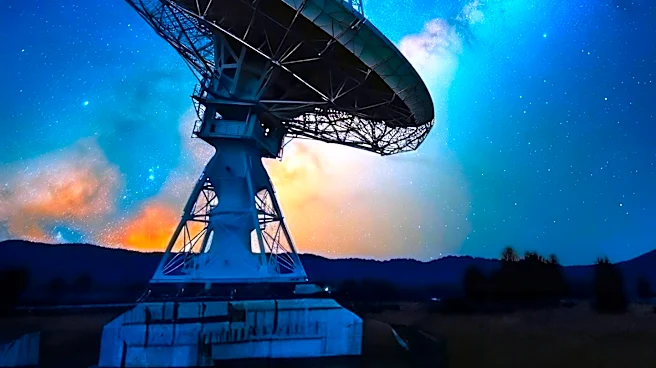
In 2020, a mysterious radio source, ASKAP J173608.2-321635, was detected near the center of the Milky Way, appearing six times before disappearing from follow-up searches in X-rays and infrared. The source, discovered using the Australian Square Kilometre
Array Pathfinder (ASKAP), exhibited highly polarized and variable radio signals, challenging existing astronomical categories. Despite extensive monitoring, no X-ray or infrared counterparts were found, complicating the identification of the source. The object was detected again in 2021 by MeerKAT, showing significant polarization changes, but still lacked counterparts in other wavelengths. The source's behavior does not fit neatly into known categories like flaring stars, pulsars, or magnetars, leading scientists to consider it might represent a new class of astronomical objects.
Why It's Important?
The discovery of ASKAP J173608.2-321635 highlights the limitations of current astronomical models and the potential for new discoveries in the field. The inability to categorize the source suggests gaps in our understanding of the universe, particularly in the behavior of radio sources. This finding underscores the importance of wide-field radio surveys, which are increasingly uncovering objects that do not fit into existing frameworks. The study of such anomalies could lead to the identification of new types of celestial phenomena, enhancing our knowledge of the universe's complexity and the processes governing it.
What's Next?
Astronomers aim to capture the source's activity across multiple wavelengths simultaneously to better understand its nature. Future observations will focus on identifying the environmental factors affecting the source's emissions, as well as the intrinsic properties of the object itself. Continued monitoring and analysis may eventually lead to a clearer classification or the discovery of a new class of astronomical objects, contributing to the broader understanding of cosmic phenomena.