

What's Happening?
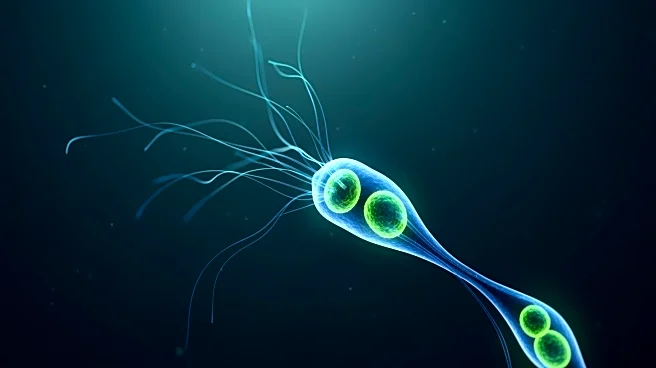
Thermococcus gammatolerans, an archaeon discovered in the Guaymas Basin in the Gulf of California, exhibits extraordinary resistance to radiation, surviving doses up to 30,000 grays. This level of resistance is 6,000 times higher than what would be lethal
to humans. Despite its habitat being far from radioactive environments, T. gammatolerans thrives in the extreme conditions of hydrothermal vents, where it endures high temperatures and chemical stress. Initial studies by microbiologist Edmond Jolivet revealed its resilience, while further research by Fabrice Confalonieri and Jean Breton explored its genetic and biochemical responses to radiation. Surprisingly, the microbe's DNA repair mechanisms appear normal, yet it efficiently limits and repairs radiation damage, possibly due to adaptations to its harsh environment.
Why It's Important?
The discovery of T. gammatolerans' radiation resistance has significant implications for understanding life in extreme environments and potential applications in biotechnology. Its ability to withstand high radiation levels without specialized DNA repair mechanisms challenges existing biological paradigms and suggests that life can adapt to extreme conditions in unexpected ways. This resilience could inform the development of new technologies for radiation protection and inspire research into other extremophiles. Additionally, understanding these mechanisms may provide insights into the potential for life in similar extreme environments beyond Earth, such as on other planets or moons with harsh conditions.