



What's Happening?
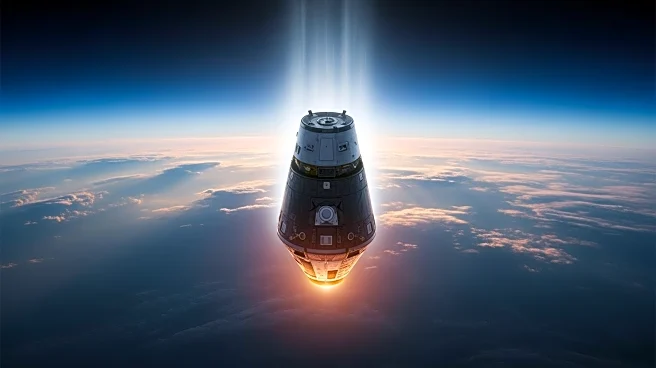
Four astronauts from the International Space Station (ISS) have returned to Earth earlier than scheduled due to an 'unexpected medical issue' affecting one of the crew members. This marks the first medical evacuation from the ISS. The SpaceX Crew-11,
which included astronauts Zena Cardman, Mike Fincke, JAXA's Kimiya Yui, and Roscosmos's Oleg Platonov, was initially set to return in late February. However, NASA decided to cut the mission short on January 8 due to the medical concern. The affected crew member, whose identity remains confidential, is reportedly in stable condition. The crew's SpaceX Crew Dragon capsule splashed down safely off the coast of San Diego, and all astronauts are undergoing routine medical evaluations.
Why It's Important?
This event underscores the complexities and risks associated with long-duration space missions. The early return of the Crew-11 astronauts highlights the importance of medical preparedness and the ability to respond swiftly to health issues in space. The mission, despite its early conclusion, contributed significantly to scientific research, including studies on bone loss in microgravity and cryogenic fluid storage. These findings have implications for both space exploration and medical advancements on Earth. The incident also emphasizes the need for robust health monitoring systems for astronauts, which could influence future mission planning and international collaboration in space exploration.
What's Next?
Following their return, the astronauts will undergo standard postflight reconditioning at NASA's Johnson Space Center in Houston. Meanwhile, the remaining ISS crew will continue their mission, with the next crew, SpaceX Crew-12, scheduled to launch in February. This upcoming mission will include NASA astronauts Jessica Meir and Jack Hathaway, ESA's Sophie Adenot, and Roscosmos's Andrey Fedyaev, who will embark on a nine-month research mission. The incident may prompt NASA and its partners to review and enhance medical protocols and emergency response strategies for future missions.