



What's Happening?
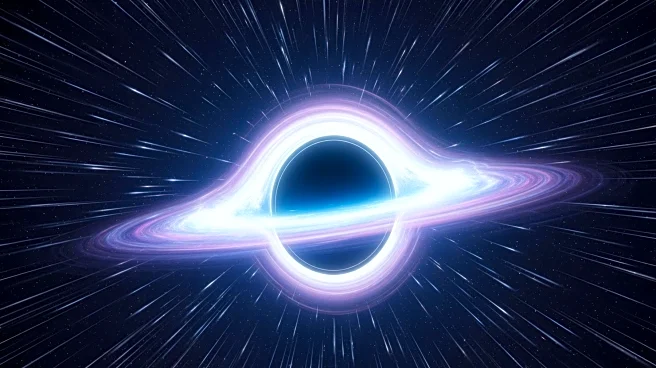
The James Webb Space Telescope (JWST) has confirmed the existence of a runaway supermassive black hole traveling at an extraordinary speed of 2.2 million miles per hour. This black hole, with a mass equivalent to 10 million suns, was observed leaving
its host galaxy and creating a trail of newly formed stars. The phenomenon was initially detected by ground-based telescopes, but JWST's infrared capabilities provided the definitive confirmation. The black hole's ejection is believed to have resulted from a merger event involving three supermassive black holes, leading to one being expelled at high velocity. This discovery marks a significant advancement in understanding black hole dynamics and galactic evolution.
Why It's Important?
This discovery is pivotal as it provides empirical evidence for theoretical predictions about black hole ejections, which have been speculated for decades. The runaway black hole's ability to trigger star formation as it moves through space challenges traditional models of star formation, suggesting that ejected black holes could play a significant role in the universe's stellar population. Additionally, the confirmation of such a high-speed black hole opens new avenues for studying black hole populations and their influence on galaxy formation. If runaway black holes are more common than previously thought, they could explain certain high-velocity objects and peculiar galactic structures observed in deep-field surveys.
What's Next?
Astronomers anticipate that JWST's ongoing surveys will uncover more runaway black holes, potentially leading to a catalog of such objects. The telescope's ability to observe in multiple wavelengths allows for comprehensive spectral analysis, crucial for distinguishing runaways from other cosmic phenomena. Future research will likely focus on refining models to incorporate this new empirical data, including the role of gravitational waves in black hole ejections. Collaborative efforts across institutions will be essential to further explore these phenomena and their implications for our understanding of the universe.
Beyond the Headlines
The confirmation of the runaway black hole highlights the importance of advanced infrared imaging in uncovering hidden cosmic phenomena. JWST's ability to penetrate dust-obscured regions is rewriting our inventory of black holes, revealing both quiescent and dynamic events. This discovery also underscores the value of international collaboration in astrophysics, as teams from various institutions pooled resources to achieve this breakthrough. The findings have sparked interdisciplinary interest, with implications for fields ranging from particle physics to cosmology.