
What's Happening?
The American Ornithological Society (AOS) and eBird have released their 2026 updates, introducing several significant bird species splits and name changes that will impact North American birders. The Willet,
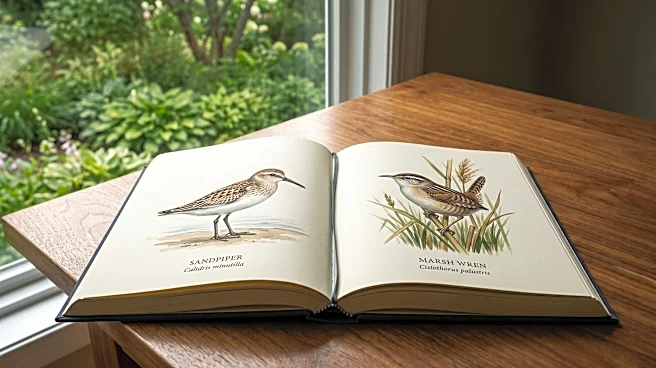
a widespread sandpiper, has been formally split into two distinct species: the Prairie Willet (Tringa inornata) and the Saltmarsh Willet (Tringa semipalmata), based on differences in range, size, and bill shape. Similarly, the Marsh Wren has been divided into the Western Marsh Wren (Cistothorus paludicola) and Eastern Marsh Wren (Cistothorus palustris), following over 40 years of research revealing genetic and song pattern differences. The Whimbrel is now separated into the Hudsonian Whimbrel (Numenius hudsonicus) in the Americas and the Eurasian Whimbrel (Numenius phaeopus) in the Old World. The Yellow Warbler's range has been halved, with the Northern Yellow Warbler (Setophaga aestiva) in North America and the Mangrove Yellow Warbler (Setophaga petechia) along coastlines from Mexico to South America. Other notable changes include the Painted Redstart becoming Painted Whitestart, the Tufted Flycatcher becoming Tawny Tufted-Flycatcher, and the Red-legged Thrush becoming Western Red-legged Thrush due to further splits. The Great Egret, previously considered a worldwide species, has been split into the Great White Egret (Eurasia, Africa, Australia) and the American Egret (Americas).
Why It's Important?
These taxonomic revisions by the AOS and eBird have a direct and immediate impact on the birding community in the U.S., requiring birders to update their life lists and learn new identification criteria. The splits, particularly for common species like the Willet and Marsh Wren, mean that many birders will gain new species on their lists, fostering renewed interest in field identification and scientific observation. For ornithological research and conservation efforts, these changes are crucial as they reflect a more accurate understanding of avian biodiversity and evolutionary relationships. This refined classification can lead to more targeted conservation strategies for newly recognized species, especially those with limited ranges or specific habitat requirements. The adoption of eBird's global list by the National Audubon Society signifies a move towards a more unified international standard for bird nomenclature, which could facilitate global data collection and collaborative research, impacting how U.S. scientists and conservationists interact with their international counterparts.
What's Next?
Birders across North America will need to familiarize themselves with the new names and identification characteristics of these split species. This will involve studying updated field guides, online resources, and recordings, particularly for species like the Marsh Wren where visual differences are subtle and song patterns are key. The AOS and eBird will continue to publish updates as scientific understanding of avian relationships evolves, ensuring that the official lists remain current. Conservation organizations and researchers will likely re-evaluate population data and conservation statuses for the newly recognized species, potentially leading to adjustments in protected areas or management plans. The shift towards a more globally aligned nomenclature, as adopted by Audubon, suggests a future where U.S. birding and conservation efforts are increasingly integrated with international standards and data, promoting broader collaboration in avian science.
Beyond the Headlines
The ongoing process of 'splitting' bird species, driven by advancements in genetic analysis and detailed observational studies, highlights the dynamic nature of scientific classification. It challenges the traditional, often visually-based, understanding of species boundaries and underscores how much remains to be discovered about biodiversity, even among well-studied groups like birds. This constant refinement of taxonomy can also spark philosophical discussions within the scientific community and among the public about what constitutes a 'species' and how these definitions influence our perception and valuation of natural world. Furthermore, the adoption of a global standard by organizations like Audubon reflects a growing recognition of the interconnectedness of ecosystems and the need for a unified approach to conservation in an era of global environmental challenges, moving beyond purely national perspectives in biological classification.