



What's Happening?
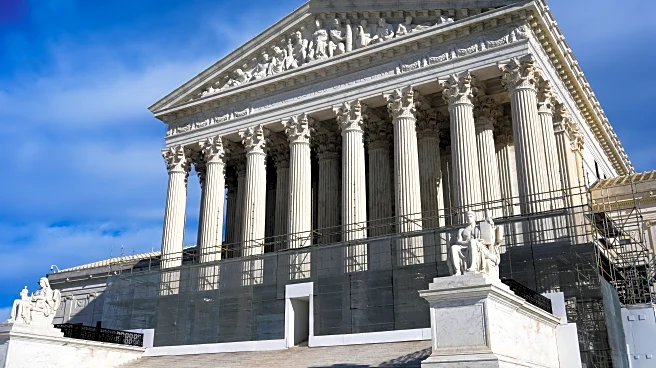
The Supreme Court recently issued a ruling that curtails President Trump's authority to impose tariffs, highlighting the need for Congress to reassert its legislative powers. The decision, which was made with a 6-3 majority, is based on the major questions
doctrine (MQD), a legal principle that requires Congress to clearly state its intentions when delegating significant powers to the executive branch. Chief Justice John G. Roberts Jr. emphasized that the statute used by President Trump did not provide the clarity and precision required by the MQD. The ruling underscores the court's reluctance to interpret ambiguous statutory texts as granting extraordinary delegations of power. Justice Neil M. Gorsuch and Justice Amy Coney Barrett provided concurring opinions, with Barrett questioning the judiciary's role in impeding constitutional actions by other branches.
Why It's Important?
This ruling is significant as it addresses the balance of power between the executive and legislative branches of the U.S. government. By limiting the president's ability to unilaterally impose tariffs, the Supreme Court is reinforcing the constitutional principle of separation of powers. This decision could have far-reaching implications for how Congress and the executive branch interact, particularly in areas with substantial political or economic consequences. It also highlights the need for Congress to be more explicit and deliberate in its legislative processes to prevent the executive from overstepping its bounds. The ruling may prompt Congress to take a more active role in defining and overseeing the powers it delegates to the executive branch.
What's Next?
The Supreme Court's decision may lead to increased scrutiny of executive actions and a push for clearer legislative guidelines. Congress might be encouraged to revisit and possibly revise existing statutes to ensure they align with the MQD and the nondelegation doctrine. This could result in legislative efforts to reclaim powers that have been gradually ceded to the executive branch. Additionally, the ruling may influence future court cases involving executive authority, setting a precedent for how similar issues are addressed. Political leaders and lawmakers will likely engage in discussions about the appropriate balance of power and the role of the judiciary in maintaining constitutional boundaries.