
What's Happening?
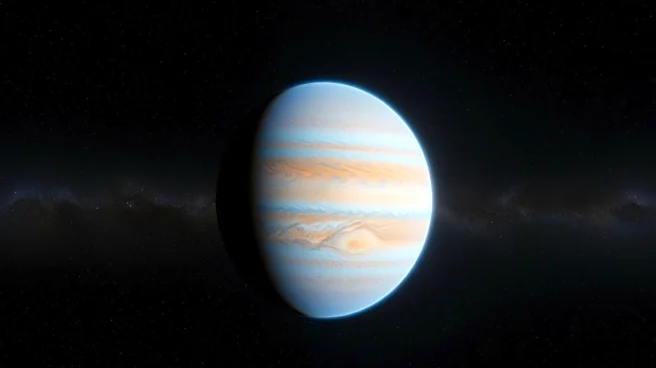
Researchers have measured the mass of a Saturn-sized rogue planet, marking a first in astronomical studies. This was achieved through a combination of ground-based and Gaia space telescope observations.
The planet, located nearly 10,000 light years away, was detected via gravitational microlensing, a method that uses the bending of light to identify celestial bodies. This discovery fills a gap in the understanding of rogue planets, which are typically either more massive than Jupiter or lighter than Neptune.
Why It's Important?
The ability to measure the mass of a rogue planet is a breakthrough in the study of these elusive celestial bodies. It provides a clearer understanding of their formation and the processes that lead to their ejection from planetary systems. This knowledge is crucial for comprehending the dynamics of planetary systems and the potential for similar occurrences in our own solar system. The discovery also highlights the effectiveness of combining different observational techniques to study distant astronomical phenomena.
What's Next?
The launch of NASA's Nancy Grace Roman Space Telescope in 2027 is expected to significantly increase the detection of rogue planets. This will enhance our understanding of their distribution and characteristics, contributing to the broader knowledge of planetary system formation. Continued advancements in telescope technology and observational methods will likely lead to more discoveries and a deeper understanding of the universe.