

What's Happening?
NASA astronaut Don Pettit recently shared an intriguing image from the International Space Station (ISS) that sparked widespread curiosity on social media. The photo depicted a tentacled object, which was humorously speculated to be an alien lifeform.
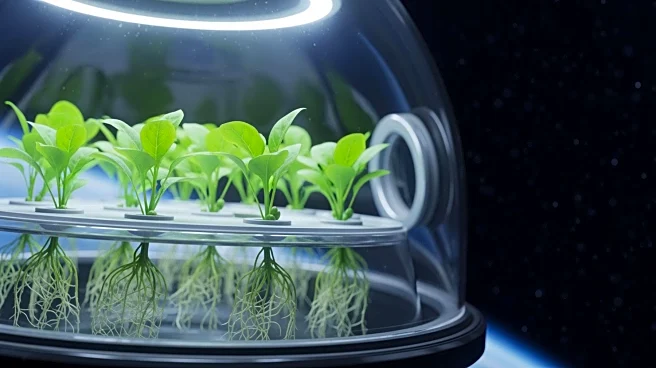
However, Pettit clarified that the object was an early purple potato, part of his personal space garden project. This initiative, conducted during his off-duty time on Expedition 72, aims to explore the feasibility of growing crops in space. The project is crucial for future long-duration missions, such as establishing bases on the Moon or Mars, where sustainable food production is essential. Pettit noted the challenges of growing plants in microgravity, such as altered root growth and slower development compared to Earth. Despite these challenges, the experiment is a significant step toward understanding space agriculture.
Why It's Important?
The ability to grow food in space is vital for the sustainability of long-term human space exploration. Potatoes, known for their high nutritional value, are a key focus due to their efficiency in terms of edible nutrition relative to total plant mass. Pettit's experiment contributes to NASA's broader research on space agriculture, which is essential for reducing reliance on Earth-based resupply missions. This research not only supports the goal of establishing a human presence on the Moon and Mars but also addresses the need for antioxidant-rich foods that can protect astronauts from space radiation. The success of such experiments could pave the way for future space missions and the development of sustainable life-support systems in space.
What's Next?
NASA continues to plan for the future of space agriculture, with ongoing experiments on the ISS and future missions to the Moon and Mars. Pettit has indicated that more insights and images from his space garden project will be shared, potentially revealing further advancements in crop viability in space. As the ISS nears the end of its design life, NASA is also preparing for the next generation of space stations, which will likely incorporate lessons learned from current agricultural experiments. These efforts are part of a larger vision to establish a permanent human presence beyond Earth, with sustainable food production as a cornerstone of this endeavor.