










What's Happening?
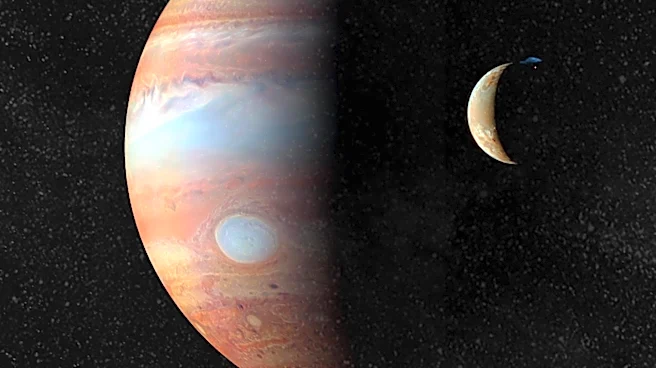
Europa, one of Jupiter's moons, is believed to harbor a subsurface ocean containing more liquid water than all of Earth's oceans combined. This ocean, kept warm by the gravitational pull of Jupiter, lies beneath Europa's icy surface. The conclusion is based
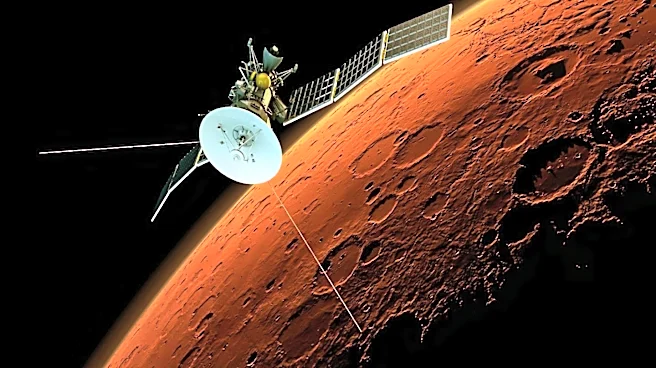
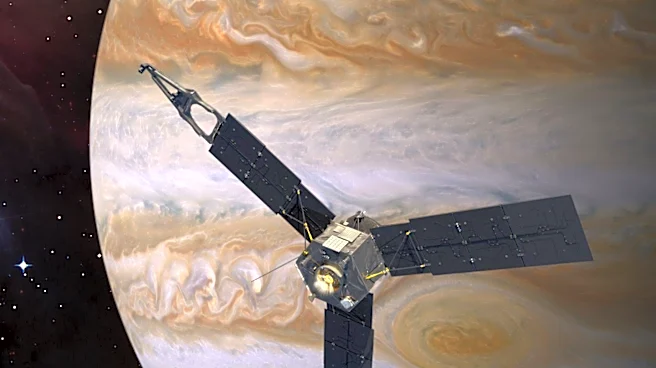
on indirect evidence such as magnetic measurements and surface geology. NASA's Galileo spacecraft provided some of the strongest evidence by detecting a changing magnetic field around Europa, suggesting an electrically conductive layer of salty liquid water. The Europa Clipper mission, set to arrive in 2030, aims to further investigate the moon's potential to support life.
Why It's Important?
The potential existence of a vast ocean beneath Europa's ice makes it a prime target for astrobiology. Understanding Europa's ocean could provide insights into the conditions necessary for life beyond Earth. The presence of liquid water, combined with energy from tidal heating, suggests that Europa could have the right conditions to support life. This discovery could reshape our understanding of habitable environments in the solar system and guide future exploration missions aimed at finding extraterrestrial life.
What's Next?
NASA's Europa Clipper mission will conduct 49 close flybys of Europa to gather detailed data on the moon's ice shell and subsurface ocean. The mission will use ice-penetrating radar, magnetic and gravity measurements, and high-resolution imaging to assess the ocean's properties and Europa's potential habitability. These observations will help determine the ocean's depth, salinity, and interaction with the surface, providing critical information for future missions that may attempt to directly explore Europa's ocean.