







What's Happening?
The IRS has issued Notice CP321J to taxpayers, clarifying the nature of the Saver's Match program and distinguishing it from other proposed payments. This notice informs individuals about a potential federal match for retirement contributions made in 2027,
which can be up to 50% of the first $2,000 contributed, totaling a maximum of $1,000 per eligible person. For married couples, this could reach $2,000 if both spouses qualify and contribute sufficiently. The IRS emphasizes that this is not a direct cash payment or a stimulus check, but rather a contribution to a retirement account. The notice is an early heads-up based on 2025 tax information, and actual eligibility will depend on 2027 income, filing status, and contributions. This clarification comes amidst public confusion, partly due to a separate, unapproved legislative proposal for a $2,000 tariff rebate.
Why It's Important?
This clarification is crucial for taxpayers to understand the distinction between a retirement savings incentive and a direct cash payment, preventing potential financial misplanning or susceptibility to scams. The Saver's Match, established through SECURE 2.0 in 2022, aims to encourage long-term retirement savings, particularly for low- and middle-income individuals, by providing a government contribution directly into eligible retirement accounts. This differs significantly from previous pandemic-era stimulus checks, which were direct payments intended for immediate economic relief. Misinterpreting the CP321J notice as a forthcoming cash payment could lead individuals to make premature financial decisions or fall victim to fraudulent schemes. The program's focus on retirement savings highlights a shift in federal policy towards encouraging financial stability through long-term planning rather than short-term aid.
What's Next?
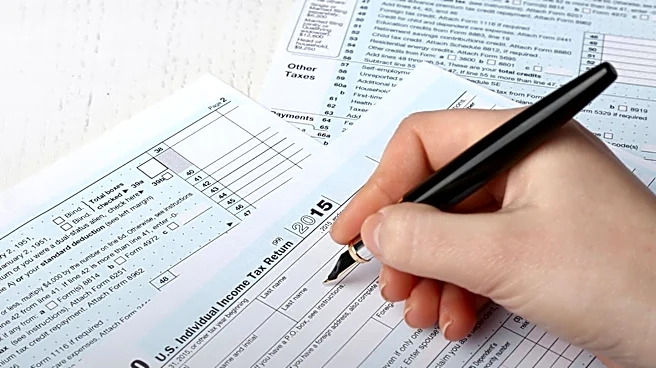
Taxpayers who received Notice CP321J should understand that no immediate action is required in 2026, and no cash payment is forthcoming. The program will apply to retirement contributions made in 2027, with claims to be filed on Form 8880-A with their 2027 federal tax return in 2028. Eligibility will be determined by 2027 income levels, filing status, and the amount contributed to eligible retirement accounts such as 401(k)s, IRAs, and 403(b)s. The IRS advises taxpayers to rely on official IRS channels for information and to be wary of any unsolicited communications requesting fees or personal information related to this notice. The separate American Tariff Rebate Act, proposing a $2,000 refundable credit, remains a legislative proposal and is not yet law, meaning no payments are scheduled under that initiative.
Beyond the Headlines
The confusion surrounding the Saver's Match and other proposed payments underscores a broader challenge in public communication regarding complex financial legislation and government programs. The term 'stimulus check' has become widely associated with direct cash payments, leading to potential misinterpretations when new programs with different structures are introduced. This situation highlights the need for clear and consistent messaging from government agencies to prevent misinformation and manage public expectations. Furthermore, the existence of both a retirement savings match and a proposed tariff rebate reflects ongoing policy debates about the most effective ways to provide economic relief and encourage financial well-being, whether through direct aid, savings incentives, or tax adjustments. The ethical dimension involves ensuring that vulnerable populations are not misled by ambiguous terminology or predatory scams that capitalize on the desire for financial assistance.