


What's Happening?
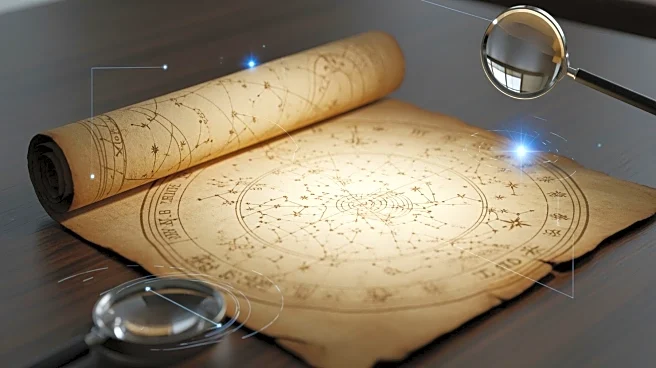
Researchers at the SLAC National Accelerator Laboratory have successfully recovered parts of the ancient Hipparchus star catalog, which had been overwritten on a palimpsest manuscript. This discovery was made possible through the use of a synchrotron,
which employs X-rays to reveal erased text. The Hipparchus catalog, created over 2,150 years ago, is considered the first star catalog and was lost over time. The recent findings were made on the Codex Climaci Rescriptus, a manuscript that had been overwritten multiple times. The research team, led by Victor Gysembergh from Sorbonne University, aims to recover as many star coordinates as possible to understand ancient astronomical methods.
Why It's Important?
The recovery of the Hipparchus star catalog is significant as it provides insights into ancient astronomical practices and the precision with which early astronomers mapped the sky without telescopes. This discovery not only enriches historical knowledge but also demonstrates the potential of modern technology in uncovering lost historical data. The findings could influence current astronomical studies by providing a historical benchmark for celestial mapping. Additionally, the research highlights the importance of preserving ancient manuscripts and the role of advanced imaging techniques in historical research.