

What's Happening?
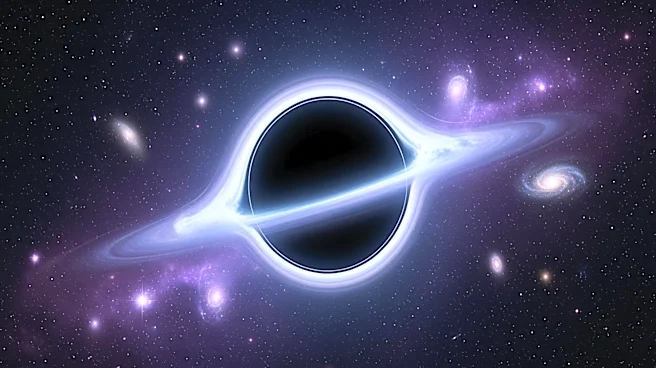
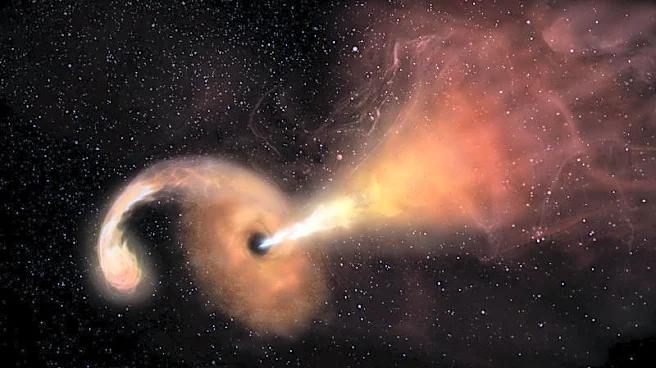
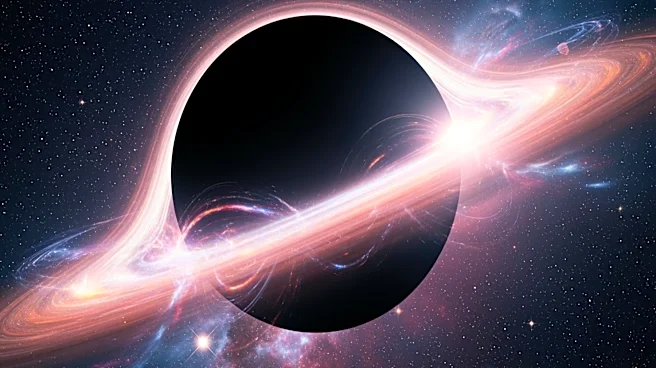
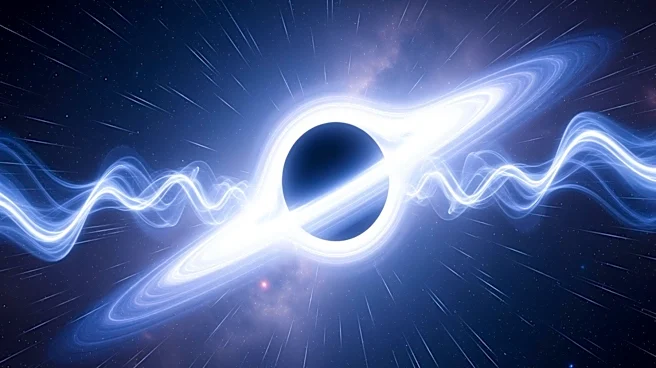
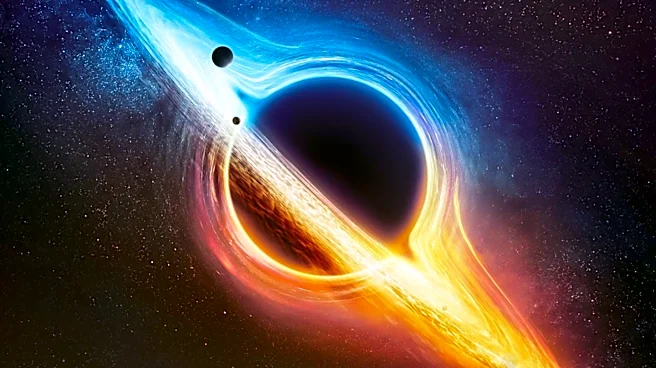
A team of researchers led by York University has discovered the fastest wind near a supermassive black hole ever found at ultraviolet wavelengths. This wind, associated with a quasar known as J2318, is moving at 30% of the speed of light. The quasar's
black hole has a mass 1.7 billion times that of the sun. The discovery was made using data from the Sloan Digital Sky Survey and confirmed with observations from the Gemini North telescope in Hawai'i. The wind is driven by the light from the quasar, which pushes gas away from the black hole at extreme velocities.
Why It's Important?
This discovery is significant as it provides new insights into the dynamics of quasars and the role of winds in galaxy evolution. The extreme speed of the wind suggests that it carries substantial energy, which can affect the surrounding galaxy. Understanding these winds is crucial for modeling galaxy formation and evolution, as they represent a feedback mechanism between the central black hole and the galaxy. The findings also demonstrate the potential for undergraduate students to contribute to significant scientific discoveries through collaborative research initiatives.
What's Next?
Researchers will continue to search for more high-velocity outflows from quasars, aiming to understand their impact on galaxies. Further studies will focus on the mechanisms driving these winds and their role in the broader context of galaxy evolution. The ongoing analysis of data from the Sloan Digital Sky Survey and other telescopes will be crucial in identifying additional quasars with similar characteristics.