






What's Happening?
Transport for NSW has initiated a year-long trial named 'Project Guardian,' utilizing real-time detection and sensing technology to identify risky behaviors such as incursions into rail corridors and dangerous pedestrian activity on highways. The technology,
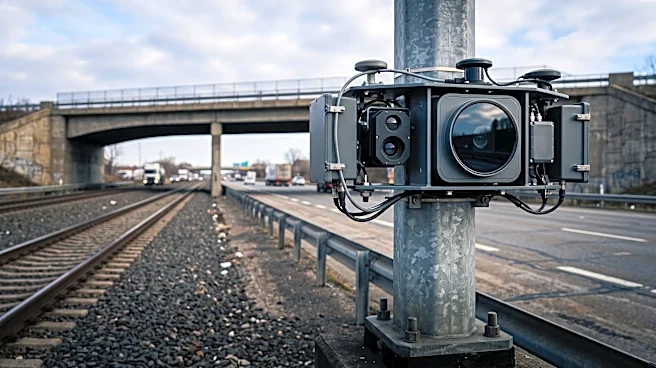
which includes LiDAR, thermal imaging cameras, and Wi-Fi/Bluetooth connectivity, is being deployed at three key locations: Kingswood Station in Penrith, and the Douglas Park and Pheasants Nest bridges on the Hume Highway, south of Sydney. Since its implementation, the system has detected 350 instances of people crossing the rail corridor at Kingswood, three cases of kangaroos in the corridor, and approximately 500 instances of dangerous pedestrian activity on the Hume Highway, including base jumpers. Coordinator General Howard Collins stated that the trial aims to identify risks earlier to prevent harm and reduce disruptions to the transport network. Technology company 4Zero has indicated its involvement, noting that the technology incorporates solutions from Microsoft, Cisco, Converge Cloud, and IPTEL.
Why It's Important?
This initiative by Transport for NSW is crucial for enhancing public safety and operational efficiency across the transportation network. By proactively identifying dangerous behaviors, 'Project Guardian' can significantly reduce the number of accidents, injuries, and fatalities associated with rail and highway incursions. The real-time data collection provides valuable insights into high-risk areas and behaviors, enabling authorities to implement targeted interventions and preventative measures. This technological advancement can also lead to fewer disruptions in public transport services, improving reliability and passenger experience. For the U.S., this project serves as a case study for how advanced sensing technologies can be integrated into existing infrastructure to address similar safety challenges in its own extensive rail and highway systems. The success of such trials could influence policy decisions and investment in smart infrastructure solutions aimed at public safety and operational resilience.
What's Next?
Following the initial year-long trial, Transport for NSW plans to evaluate the effectiveness of 'Project Guardian' and potentially expand the technology to additional locations. The data collected during this period will be analyzed to refine detection algorithms and optimize system performance. Authorities will likely use the insights gained to develop new public awareness campaigns or modify existing safety protocols to address identified risk patterns. There may also be discussions with technology providers to enhance the capabilities of the sensing equipment and integrate it with broader smart city initiatives. The project's outcomes could also inform regulatory bodies about the potential for mandating similar technologies in other critical infrastructure sectors, both within Australia and internationally, including the U.S., as a standard for public safety and operational management.
Beyond the Headlines
The implementation of 'Project Guardian' highlights a growing trend towards leveraging advanced surveillance and sensing technologies for public safety, raising deeper implications regarding privacy and data governance. While the primary goal is safety, the continuous monitoring of public spaces through LiDAR, thermal imaging, and connectivity data necessitates robust frameworks for data collection, storage, and usage to protect individual privacy. This project also underscores the increasing reliance on artificial intelligence and machine learning to interpret complex data patterns and identify anomalies, transforming how public infrastructure is managed. Ethically, striking a balance between security needs and civil liberties will be a critical ongoing challenge. Furthermore, the integration of multiple technology vendors (Microsoft, Cisco, etc.) points to the complexity of modern infrastructure projects, requiring seamless interoperability and cybersecurity measures to prevent vulnerabilities and ensure system integrity.