







What's Happening?
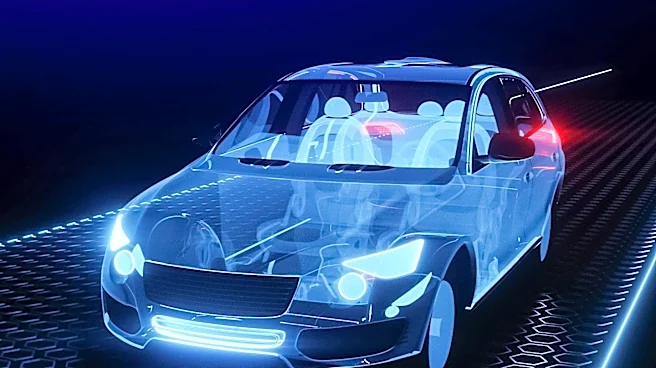
Vehicle-to-Everything (V2X) technology is enhancing the safety of electric vehicles (EVs) by enabling them to exchange live data with other vehicles, road infrastructure, and pedestrians. This system addresses the limitations of current safety features
like cameras and radar, which can only detect what is directly visible. V2X encompasses Vehicle-to-Vehicle (V2V) communication, allowing EVs to share real-time data on position, speed, direction, and braking with nearby vehicles, providing warnings about hazards beyond the line of sight. Vehicle-to-Infrastructure (V2I) connects vehicles with traffic lights and roadside systems, offering advance notice of signal changes to prevent sudden braking and rear-end collisions. Additionally, Vehicle-to-Pedestrian (V2P) settings can notify an approaching car about a pedestrian's location, particularly useful in blind spots or when individuals emerge from between parked cars, potentially reducing impact severity and frequency.
Why It's Important?
The integration of V2X technology into electric vehicles represents a significant leap forward in road safety, with the potential to drastically reduce accidents and their severity. By providing drivers with information about unseen hazards, V2X systems can prevent collisions that current advanced driver-assistance systems (ADAS) cannot. The U.S. Department of Transportation has recognized the potential of V2V communication to mitigate a substantial number of road collisions. Furthermore, V2I capabilities can optimize traffic flow and reduce the likelihood of intersection-related accidents, which are often severe. The data captured by V2X systems can also be crucial in legal and insurance contexts, offering clear records of events leading up to an accident. This technology not only protects drivers and passengers but also enhances the safety of pedestrians, contributing to a more secure and efficient transportation ecosystem.
What's Next?
The widespread adoption and full potential of V2X technology depend on its continued development and broader implementation across vehicles and road systems. Future steps will involve increasing the number of V2X-equipped vehicles on the road and expanding compatible infrastructure. Addressing privacy concerns related to continuous location sharing for V2P systems will also be critical for public acceptance. As the technology matures, it is expected to integrate more seamlessly with existing ADAS features, creating a more robust safety net. Ongoing research and development will likely focus on refining V2X communication protocols, improving data accuracy, and ensuring interoperability between different manufacturers and infrastructure providers. The ultimate goal is to create a fully connected transportation environment where real-time data exchange significantly reduces road accidents.
Beyond the Headlines
Beyond its immediate safety benefits, V2X technology has profound implications for the future of urban planning, emergency response, and autonomous driving. In urban environments, V2X can enable intelligent traffic management systems that dynamically adjust to real-time conditions, reducing congestion and emissions. For emergency services, immediate access to accident data and vehicle locations can significantly improve response times. Furthermore, V2X is a foundational technology for fully autonomous vehicles, providing the crucial environmental awareness and communication capabilities needed for safe and efficient operation without human intervention. The ethical considerations surrounding data privacy and the potential for system vulnerabilities will also become increasingly important as V2X becomes more ubiquitous, necessitating robust regulatory frameworks and cybersecurity measures to ensure public trust and safety.