



What's Happening?
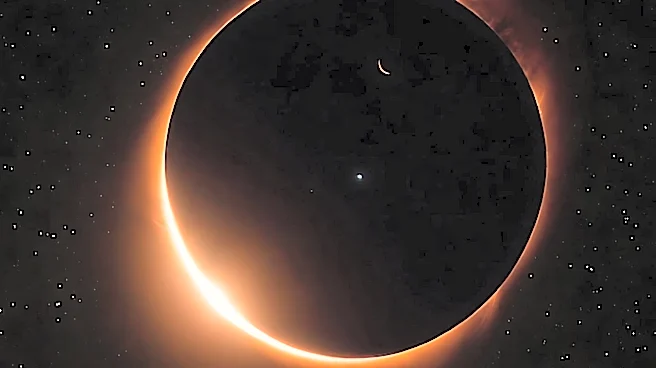
During NASA's Artemis 2 mission on April 6, 2026, astronauts experienced a rare total solar eclipse from the vicinity of the moon. The crew, including NASA astronaut Victor Glover, observed the sun being obscured by the moon, describing the sight as 'a
hole in the universe.' This unique vantage point provided valuable scientific observations of the sun's corona, which is typically hidden by the star's bright light. The eclipse was an extraordinary coincidence, as the mission's timing coincided perfectly with the celestial event.
Why It's Important?
The observations made during the eclipse offer significant scientific value, particularly in understanding the sun's corona and its impact on space weather. This knowledge is crucial for predicting solar phenomena that can affect Earth's atmosphere and satellites. As humanity prepares for more lunar missions, understanding solar activity becomes increasingly important for the safety of astronauts and equipment. The Artemis 2 mission's success in capturing this rare event highlights the potential for future scientific discoveries from lunar exploration.
Beyond the Headlines
The experience of witnessing a solar eclipse from space underscores the awe and wonder of space exploration. It also emphasizes the importance of international collaboration in advancing our understanding of the universe. The Artemis program, with its focus on returning humans to the moon, represents a new era of exploration that could lead to further breakthroughs in space science and technology. The mission's success in capturing the eclipse also demonstrates the potential for using space-based observations to enhance our knowledge of celestial events.