



What's Happening?
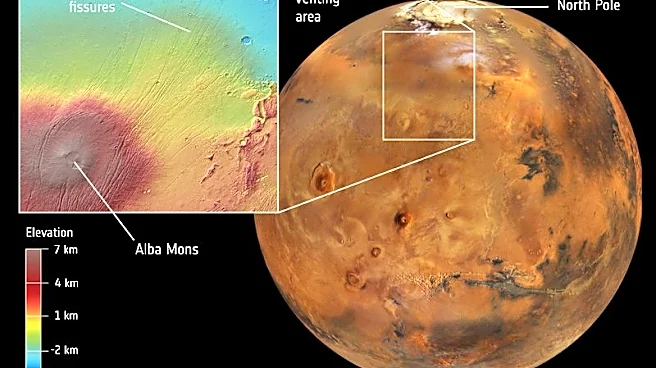
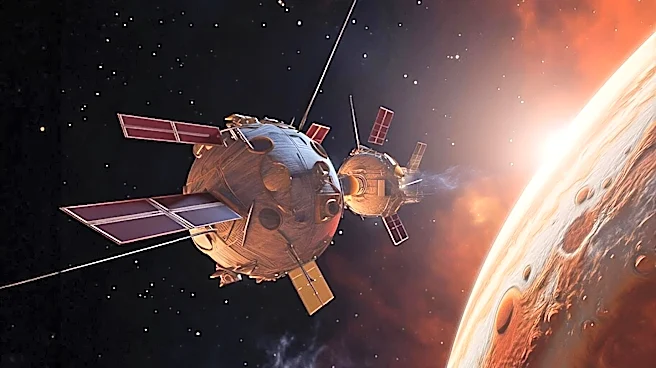
The European Space Agency's ExoMars Trace Gas Orbiter (TGO) has detected localized pulses of hydrogen chloride (HCl) gas emanating from fracture systems on the flanks of Alba Mons, Mars's largest volcano by surface area. This discovery, published in Science
Advances on November 4, provides the first atmospheric chemistry evidence suggesting that Alba Mons may still be geologically active, challenging the long-held assumption that it is extinct. The HCl detections occurred during the Martian spring and summer, leading researchers to propose a 'seasonal pressure-valve' effect, where subsurface gases build up during winter under carbon dioxide frost and are released as the frost sublimates. The instrument used, the Atmospheric Chemistry Suite (ACS), is significantly more sensitive than previous thermal surveys, allowing for the detection of trace gases at concentrations 100 times fainter.
Why It's Important?
This finding is significant because it redefines our understanding of Mars's geological activity. If Alba Mons is indeed geologically active, it implies that the planet's interior may still retain sufficient heat to sustain magmatic processes, even if not actively erupting. This has profound implications for the search for life on Mars, as active hydrothermal systems, driven by geological heat, are considered prime candidates for environments where liquid water and energy sources could coexist underground, shielded from harsh surface conditions. Such environments on Earth support chemosynthetic organisms. The detection of HCl, a common volcanic emission on Earth, suggests that Mars's habitability story might not be entirely in the past tense, opening new avenues for astrobiological research and future missions.
What's Next?
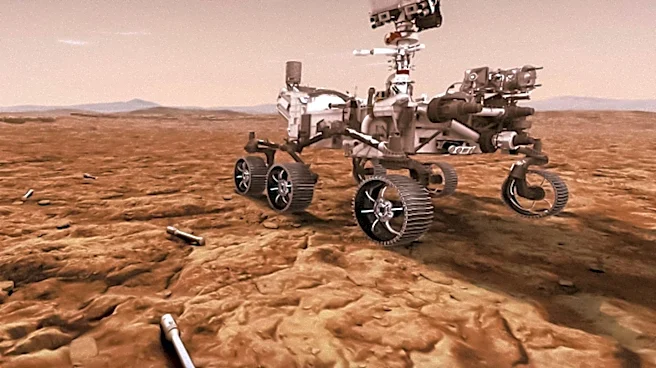
Future research will focus on distinguishing whether the HCl pulses originate from a currently active magmatic source or from a geochemically active but magmatically cold hydrothermal system. The ExoMars Rosalind Franklin rover, scheduled for launch by 2028, will carry a drill capable of reaching two meters below the Martian surface, potentially accessing geochemically active material that current orbiters cannot. Continued observations by the TGO over multiple Martian years will help determine if the detected HCl is part of a systematic seasonal pattern or a one-time anomaly. These efforts aim to provide more direct evidence of subsurface activity and further refine our understanding of Mars's internal processes and potential for supporting life.
Beyond the Headlines
The detection of hydrogen chloride on Mars, particularly in localized seasonal pulses, opens up a fascinating debate about the planet's internal dynamics and its potential for harboring life. Beyond the immediate scientific implications, this discovery highlights the power of advanced atmospheric chemistry instruments in revealing subtle yet crucial details about planetary environments. It underscores the idea that geological activity can manifest in ways not immediately apparent through traditional observational methods. The possibility of ongoing hydrothermal systems on Mars could fundamentally alter our search strategies for extraterrestrial life, shifting focus to subsurface environments where conditions might be more favorable than on the surface. This also prompts a broader philosophical question about the definition of a 'geologically dead' planet and the diverse forms that planetary activity can take.