




What's Happening?
The federal government has finalized new rules for managing the Colorado River through 2028, preventing Arizona from facing the most severe water cuts in its history. The U.S. Department of the Interior's Record of Decision adopts a water-sharing plan
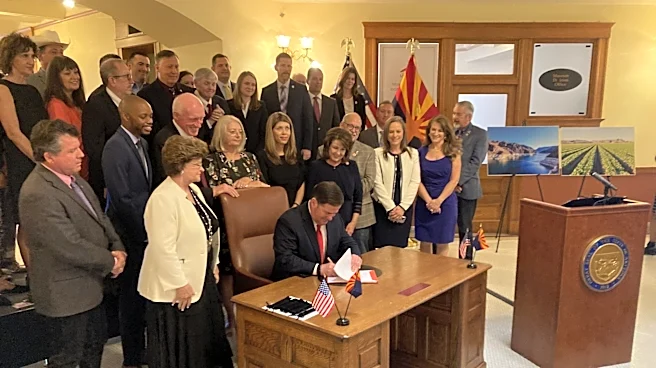
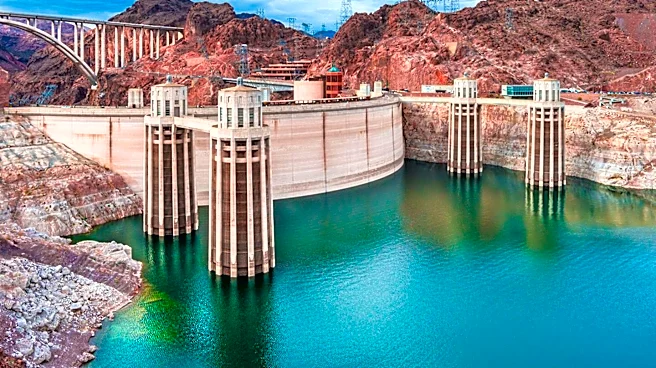
developed collaboratively by Arizona, California, and Nevada, rather than imposing unilateral federal reductions. Under this plan, Arizona will experience a cut of approximately 30% to its overall water allocation from the Colorado River, with the Central Arizona Project (CAP) facing a 50% reduction. This outcome is considered a 'win' by Governor Katie Hobbs compared to earlier proposals that could have seen cuts of up to 77% to CAP's water supply. Despite these cuts, state leaders indicate that residents' access to tap water should not be affected, as cities like Phoenix have been preparing for such reductions for a decade by developing backup water supplies from the Salt and Verde rivers. The plan also mandates Lower Basin states to voluntarily conserve an additional 700,000 acre-feet over the next two years, contributing to a broader conservation effort of over 3.2 million acre-feet in Lake Mead.
Why It's Important?
This federal water deal is crucial for Arizona as it mitigates a potentially devastating economic impact that would have resulted from more severe, federally imposed water cuts. Arizona holds the lowest-priority water rights among the Lower Basin states under the century-old compact governing the Colorado River, making it highly vulnerable to reductions. The agreement provides two years of stability for the state's water supply, allowing cities and agricultural sectors to adapt to the new allocation levels. While residents may not immediately experience disruptions in tap water supply, the long-term financial implications are significant, with warnings of higher water bills as cities rely on more expensive backup supplies. The deal also highlights the ongoing tension between Upper and Lower Basin states regarding water allocation, with Governor Hobbs criticizing the Upper Basin states for not facing mandatory cuts and threatening legal action if further cuts are imposed without their accountability. This situation underscores the broader challenge of water scarcity in the American West, driven by decades of drought, climate change, and overuse, affecting 40 million people and vast agricultural lands.
What's Next?
Arizona will proceed with implementing the approximately 30% cut to its Colorado River water allocation, with the Central Arizona Project (CAP) facing a 50% reduction. Cities like Cave Creek, which heavily rely on CAP water, will continue to pursue short-term water exchange agreements to manage the immediate impact of the cuts. Longer-term, city councils will need to consider and approve more expensive solutions for sustainable water supplies. Federal officials have left open the possibility of deeper cuts if conditions at Lake Powell and Lake Mead do not improve, which could trigger further legal action from Arizona, as indicated by Governor Katie Hobbs. The state remains prepared to protect its water rights by any legal means necessary. The Lower Basin states are also required to voluntarily conserve an additional 700,000 acre-feet over the next two years, contributing to a larger conservation effort in Lake Mead. The Bureau of Reclamation will continue to coordinate operations at reservoirs to protect critical elevation levels, particularly at Lake Powell, with lower-than-typical releases planned for the upcoming water year.
Beyond the Headlines
The Colorado River water deal extends beyond immediate water allocations, revealing deeper implications for regional governance, economic development, and environmental sustainability in the American West. The collaborative, albeit contentious, negotiation process among Arizona, California, and Nevada, contrasted with the lack of mandatory cuts for Upper Basin states, highlights the complex political dynamics and historical water rights that govern the river. This situation could set precedents for future interstate water agreements and potentially lead to re-evaluations of the century-old Colorado River Compact. Economically, the shift towards more expensive backup water sources will likely accelerate innovation in water conservation technologies and infrastructure, but also place increased financial burdens on consumers and industries. Environmentally, the ongoing need for significant conservation efforts underscores the severe impact of climate change and prolonged drought on vital natural resources, pushing states to confront the long-term viability of current water usage patterns and potentially leading to more sustainable land use and agricultural practices in the region.