



What's Happening?
Christina Weber, an Honors Program student from Brookdale Community College, presented her research on microplastic bioaccumulation in marine copepods at Atlantic Plastics 2026, the Third International Symposium on Marine Plastic Pollution, held in Reykjavik,
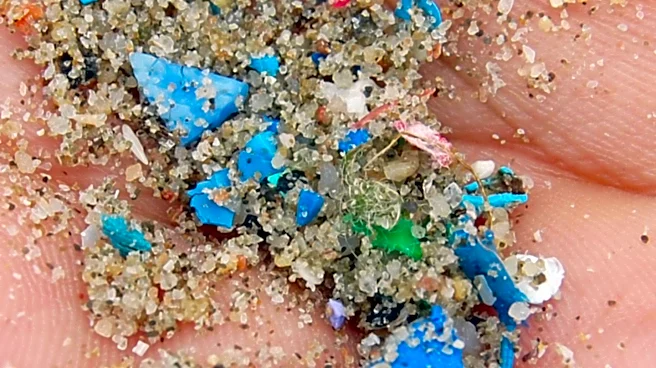
Iceland. Weber's project, titled 'Microplastic Bioaccumulation in Marine Copepods: An Accessible Approach,' investigated how food scarcity influences the accumulation of microplastics in marine organisms. She developed her own methodology and built specialized equipment for her experiments. The symposium gathered 115 speakers and presenters from 31 countries, including internationally recognized scientists and global policy leaders like Ambassador Julio Cordano, chair of the Intergovernmental Negotiating Committee on Plastic Pollution, which is working towards a global treaty. Weber's participation marked a significant achievement for an undergraduate community college student, allowing her to share her findings and engage with global experts on environmental challenges.
Why It's Important?
This event highlights the critical role of scientific research, even at the community college level, in addressing pressing global environmental issues such as marine plastic pollution. Weber's research contributes to the broader understanding of microplastic accumulation in marine ecosystems, which has implications for wildlife health and potentially human health through the food chain. Her participation in an international forum underscores the necessity of global collaboration and diverse perspectives in tackling environmental challenges. The involvement of global policy leaders at the symposium, working towards a plastics treaty, indicates the growing recognition of this issue at the highest levels of governance. This engagement can inform policy decisions and foster international cooperation to mitigate plastic pollution, impacting U.S. environmental policy and scientific contributions.
What's Next?
Following her presentation, Christina Weber plans to graduate from Brookdale in May 2027 and transfer to a four-year university, with Princeton University among her top choices, to pursue a graduate degree and conduct research in marine or estuarine science. Her experience has strengthened her commitment to marine conservation and global change. The ongoing work of the Intergovernmental Negotiating Committee on Plastic Pollution, as highlighted by Ambassador Julio Cordano's presence at the symposium, suggests continued efforts towards a global treaty to address plastic pollution. This treaty, once established, could significantly impact international regulations, industrial practices, and scientific research priorities related to plastics, potentially influencing U.S. environmental policies and corporate responsibilities.
Beyond the Headlines
Weber's journey exemplifies the potential for non-traditional educational paths to lead to significant scientific contributions and global engagement. Her ability to conduct advanced research and present it on an international stage as a community college student challenges conventional notions of where groundbreaking scientific work originates. The emphasis on collaboration and listening to diverse perspectives, including those from Indigenous communities affected by pollution, points to a broader shift in scientific and policy approaches towards more inclusive and holistic solutions for environmental problems. This development could foster greater interdisciplinary and cross-cultural cooperation in addressing complex global issues, moving beyond purely scientific data to incorporate traditional knowledge and community impacts.