



What's Happening?
A team of researchers has developed a method to predict the impact locations of falling space debris by using seismometers, which are typically used to detect earthquakes. This innovative approach was detailed in a study published in the journal Science.
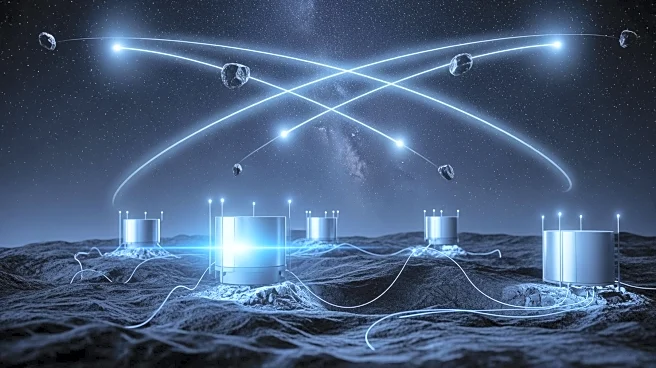
The researchers demonstrated that seismometers could track the sonic booms produced by space debris as it re-enters the Earth's atmosphere at supersonic speeds. This data allows scientists to map the trajectory of the debris and predict where it might land. The study focused on the Shenzhou-15 module, whose disintegration was tracked by sensors across California. The findings suggest that seismometers, which also detect natural phenomena like hurricanes and avalanches, can be repurposed to enhance public safety by providing warnings about potential space debris impacts.
Why It's Important?
The ability to predict where space debris will land has significant implications for public safety and space policy. As the amount of space debris increases, the risk of it causing damage to populated areas or critical infrastructure grows. This new method could help mitigate such risks by providing timely warnings, allowing for evacuations or other protective measures. Furthermore, the research highlights the potential for existing technology to be adapted for new purposes, which could lead to more cost-effective solutions in managing space debris. This development is particularly relevant as space exploration and satellite deployment continue to expand, increasing the likelihood of debris re-entering the Earth's atmosphere.
What's Next?
The next steps involve refining the technology to improve the accuracy and reliability of predictions. Researchers may also explore integrating this system with other monitoring technologies to create a comprehensive space debris tracking network. Additionally, there could be discussions among international space agencies and governments about adopting this technology as part of global efforts to manage space debris. Collaboration could lead to standardized protocols for issuing warnings and coordinating responses to potential impacts.
Beyond the Headlines
This development raises questions about the ethical responsibilities of space-faring nations to manage the debris they create. As more countries and private companies enter the space industry, there is a growing need for international regulations to address space debris. The use of seismometers for this purpose also underscores the importance of interdisciplinary approaches in solving complex global challenges. It highlights how scientific innovation can arise from unexpected sources, potentially leading to breakthroughs in other areas of research and technology.