





What's Happening?
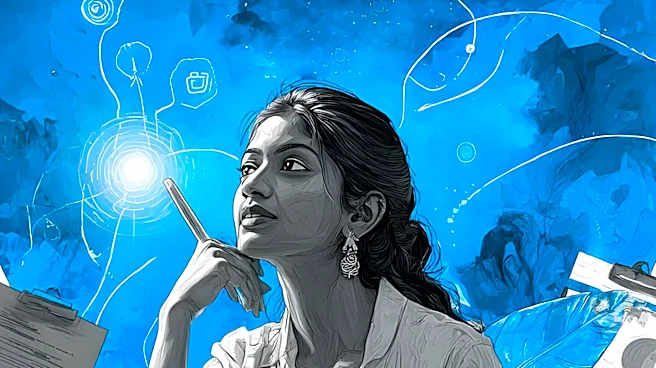
A recent report highlights the need to reassess the criteria used to identify future women scientists, particularly in the context of artificial intelligence and interdisciplinary fields. The report notes that while girls make up a significant portion
of students in advanced mathematics, they are underrepresented in physics and computer science, which are key to high-tech careers. The current educational metrics, such as Israel's High-Tech Matriculation Index, focus on traditional subjects but may not align with the skills needed in a rapidly evolving technological landscape. The report suggests that success in the 21st century requires not only expertise in a single field but also adaptability, creativity, and the ability to solve complex problems.
Why It's Important?
The reevaluation of educational criteria is crucial as it impacts the future workforce in high-tech industries, which are increasingly driven by artificial intelligence and interdisciplinary approaches. By broadening the pathways for women in science, the potential for innovation and economic growth can be significantly enhanced. The current gender gap in Israel's high-tech sector, where women are underrepresented in leadership and development roles, represents a loss of valuable human capital. Addressing this gap is not only a matter of gender equality but also a strategic necessity to maintain technological competitiveness and innovation.
What's Next?
To address these challenges, educational institutions and policymakers may need to develop new metrics that recognize a broader range of skills, such as systems thinking and cognitive flexibility. This could involve integrating interdisciplinary learning and AI applications into educational programs, as seen at the Davidson Institute of Science Education. Additionally, increasing women's participation in technological roles within the military and high-tech sectors could be a strategic move to expand the talent pool. These steps could help ensure that the educational system is aligned with the demands of a future shaped by AI and technological advancements.
Beyond the Headlines
The discussion around educational criteria also touches on ethical and cultural dimensions, such as the need to challenge traditional gender roles and biases in science and technology fields. By fostering an inclusive environment that values diverse talents and perspectives, society can better prepare for the ethical implications of AI and other emerging technologies. This shift could lead to long-term cultural changes in how success and excellence are defined in scientific and technological domains.