


What's Happening?
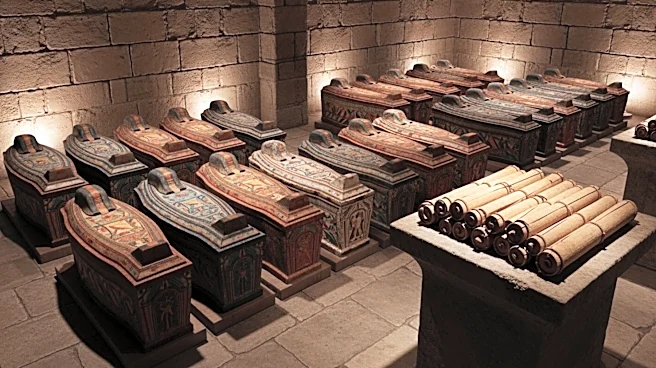
A significant archaeological discovery has been made in Luxor, Egypt, where a hidden chamber has revealed 22 painted wooden coffins belonging to the Singers of Amun, along with eight sealed papyri. This find, announced by Egypt's Ministry of Tourism and
Antiquities, was uncovered in the Asasif necropolis on Luxor's West Bank. The coffins, stacked in ten horizontal rows, contained mummified remains and were found alongside papyri stored in a ceramic vessel. The Singers of Amun were women who held formal roles in the temple's ritual life during Egypt's Third Intermediate Period. The discovery provides material evidence of a collective burial tradition tied to temple employment, offering insights into the mortuary practices of the time.
Why It's Important?
This discovery is crucial for understanding the religious and social structures of ancient Egypt, particularly during the Third Intermediate Period. The Singers of Amun were integral to the temple's operations, and their collective burial highlights the importance of their roles. The sealed papyri, described as an 'information treasure,' could provide valuable insights into temple administration, funerary rituals, and economic records. This find not only enriches the historical narrative of the period but also underscores the significance of women in religious and economic spheres. The preservation of the coffins and papyri offers a rare opportunity for further study, potentially leading to new revelations about ancient Egyptian society.
What's Next?
Conservation work on the coffins and papyri is ongoing, with efforts focused on stabilizing and documenting the artifacts. The translation and analysis of the papyri are expected to yield new information about the Singers of Amun and their roles. Archaeologists are also searching for the original tombs from which these coffins were moved, which could provide further context about the burial practices and social networks of the time. The findings may lead to a deeper understanding of the administrative and religious dynamics in ancient Thebes, contributing to the broader field of Egyptology.