





What's Happening?
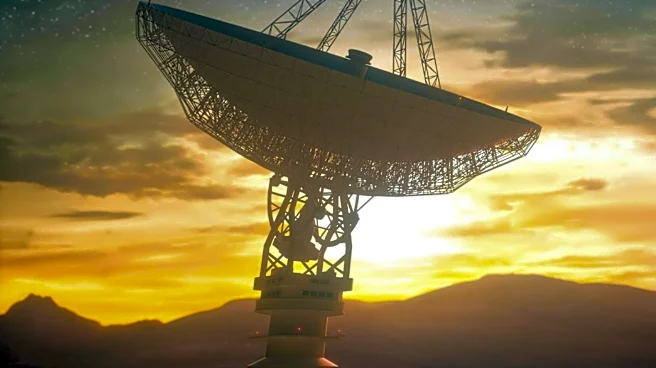
The Canadian Hydrogen Intensity Mapping Experiment (CHIME) radio telescope has successfully detected the faint glow of hydrogen gas from the distant universe, specifically from when the universe was approximately 5 billion years old. This breakthrough,
published in The Astrophysical Journal, marks a significant step in investigating dark energy, the mysterious force accelerating the universe's expansion. Unlike previous methods that relied on cross-referencing with galaxy survey data, CHIME achieved this detection using only its own data. This independent measurement allows for a faster and more cost-effective approach to studying the distribution of matter across space and understanding the nature of dark energy. The research involved extensive data analysis and processing techniques to isolate the faint signal from background noise, with scientists spending over a year verifying the finding based on 94 nights of observations from 2019.
Why It's Important?
This development is crucial for astrophysics and cosmology, offering a novel and independent method to probe the cosmos and investigate dark energy. By directly mapping the radio emission from hydrogen, CHIME can explore the universe on a greater scale and further back in time than traditional galaxy surveys, which are more expensive and limited to regions dense enough to form stars. This new technique provides an alternative way to test existing theories about dark energy, potentially proving or disproving them. The ability to conduct such research at a fraction of the cost and without reliance on other telescopes' results could significantly accelerate our understanding of the universe's expansion and fundamental physics. The findings also offer insights into how galaxies form and evolve by measuring the distribution and clustering of hydrogen.
What's Next?
Researchers are now working to expand their analysis to include earlier periods in cosmic history, aiming to study the universe when it was only 3 billion years old, utilizing nearly seven years of accumulated data from CHIME. This ongoing work will provide a more comprehensive understanding of the early universe and the evolution of hydrogen distribution. The success of this technique is expected to encourage further development and application of hydrogen mapping with similar telescopes, opening new avenues for cosmological research. Future studies will likely focus on refining the data analysis to extract even more information about the universe's past and the properties of dark energy, potentially leading to new discoveries about galaxies and the fundamental forces governing the cosmos.
Beyond the Headlines
The successful detection of distant hydrogen signals by CHIME represents a paradigm shift in cosmological observation, moving towards more autonomous and cost-efficient methods. This could democratize access to high-level astrophysical research, allowing more institutions and countries to contribute to our understanding of the universe without requiring multi-million dollar investments in galaxy surveys. The ability to independently verify and explore theories of dark energy also has profound implications for our understanding of the universe's ultimate fate. If dark energy continues to accelerate expansion, it could lead to a 'Big Rip' scenario, while other theories suggest different outcomes. This research provides a critical tool for distinguishing between these possibilities, shaping our long-term cosmic perspective and potentially influencing future space exploration strategies.