
What's Happening?
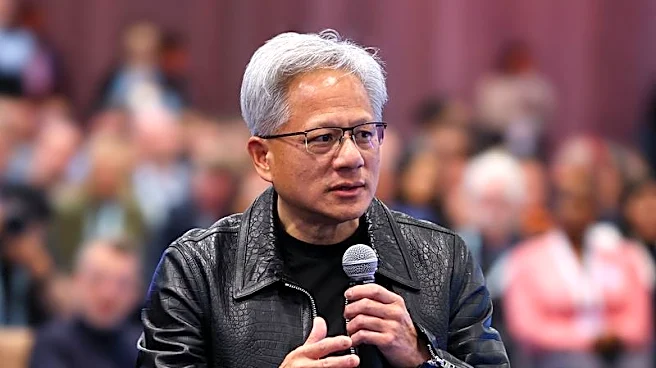
A recent interview between The New York Times' Ezra Klein and Nvidia CEO Jensen Huang highlighted a significant divergence in perspectives regarding artificial intelligence safety and regulation. Klein pressed
Huang on issues such as AI safety, collective-action problems, employment impacts, and the necessity of regulation, as well as the scale of investment in AI. Huang, in response, maintained an engineering-centric view, asserting that unsafe models should not be deployed, safety is primarily an engineering challenge, and increased computational power will enhance AI safety and utility. He also suggested that AI would ultimately create new job opportunities due to the unlimited nature of human desires. The core of their disagreement centered not on specific facts, but on the fundamental nature of AI systems, the types of risks they pose, and the very understanding of knowledge in this evolving field.
Why It's Important?
The differing viewpoints between a leading AI industry figure like Jensen Huang and a prominent journalist like Ezra Klein underscore a critical debate with far-reaching implications for the U.S. and global technology landscape. Huang's stance, which emphasizes internal engineering solutions and dismisses the need for external regulatory mechanisms, creates what is described as a 'prisoner's dilemma.' This scenario suggests that while all frontier AI model companies might benefit from a slower, more cautious development pace, individual firms are incentivized to accelerate due to the immediate and substantial gains from being first, fearing that competitors will not slow down. This dynamic could lead to a 'race to the bottom' in safety standards, where the long-term, distributed costs of potential AI failures are poorly addressed by current legal frameworks. The lack of consensus on how to enforce responsible AI development could expose society to unforeseen risks, impacting various sectors from national security to economic stability.
What's Next?
The ongoing debate between industry leaders and public intellectuals regarding AI safety and regulation is likely to intensify as AI technology continues to advance. Without a clear framework for collective action, the 'prisoner's dilemma' described could lead to continued rapid development without adequate safeguards. This situation may prompt increased calls for governmental intervention and the establishment of regulatory bodies to oversee AI development and deployment. Stakeholders, including policymakers, civil society groups, and even some within the tech industry, may push for mechanisms that compel companies to prioritize safety and ethical considerations over immediate competitive advantages. The outcome of this debate will significantly influence future legislation, industry standards, and the public's trust in AI technologies, potentially shaping the trajectory of technological innovation and its societal integration.
Beyond the Headlines
The fundamental disagreement between Jensen Huang and Ezra Klein extends beyond immediate regulatory concerns, touching upon deeper ethical and philosophical questions about the nature of AI and human responsibility. Huang's assertion that 'unsafe models should not be shipped' and that 'safety is an engineering problem' reflects a technocratic optimism that may overlook the complex, emergent properties of advanced AI systems. The 'prisoner's dilemma' highlights a systemic issue where individual corporate incentives can conflict with collective societal well-being, raising questions about corporate governance and the limits of self-regulation in rapidly evolving, high-stakes technological fields. This situation could trigger a broader societal discussion on how to balance innovation with caution, and whether current legal and ethical frameworks are adequate to address the unprecedented challenges posed by artificial intelligence. The long-term implications could include a re-evaluation of corporate liability, the development of new international norms for AI, and a shift in public perception regarding the role of technology in shaping human destiny.