
What's Happening?
The global wind industry has unveiled a new declaration at COP31 in Türkiye, outlining a strategic pathway to significantly accelerate wind power deployment worldwide. This initiative, spearheaded by the
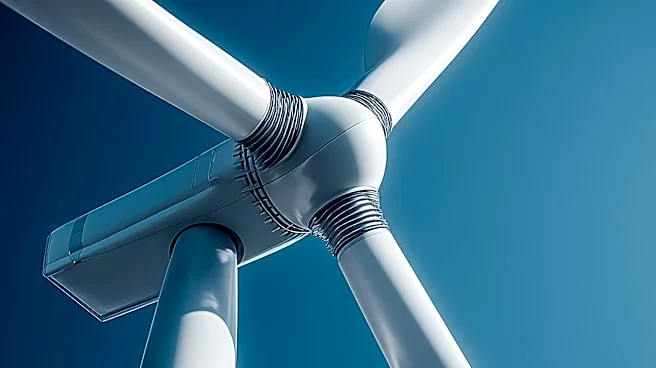
Global Wind Energy Council (GWEC) in partnership with the Turkish Wind Energy Association (TUREB), aims to potentially increase installed wind capacity to 4 terawatts (TW) by 2035. The 'Global Wind Declaration for Powering the Future' sets forth industry commitments and provides recommendations for governments to unlock necessary investments and expedite the development of wind farms. The declaration emphasizes the need for closer cooperation among governments, industry stakeholders, and financial institutions to overcome existing barriers to deployment. This comes as global installed wind capacity reached 1,299 gigawatts (GW) at the end of 2025, with a record 165 GW added during that year, marking a 40% increase from the previous record. GWEC's modeling suggests that current trends would lead to 2 TW by 2029 and 3 TW by 2035, but stronger governmental support could push this to 4 TW.
Why It's Important?
This declaration is crucial for the U.S. and the global energy landscape as it highlights a concerted effort to transition towards renewable energy sources, directly impacting climate change mitigation goals. For the U.S., increased global wind capacity could influence domestic energy policy, investment in renewable infrastructure, and technological advancements in wind power. The call for more predictable policy frameworks, faster permitting processes, improved grid infrastructure, and better access to finance directly addresses challenges faced by renewable energy projects in the U.S. and elsewhere. If successful, this initiative could lead to a more stable and attractive investment environment for wind energy, potentially drawing more capital into the sector and creating jobs in manufacturing, construction, and maintenance. Conversely, failure to implement these recommendations could hinder the U.S.'s ability to meet its climate targets and remain competitive in the global renewable energy market, affecting energy security and economic growth.
What's Next?
The declaration sets out five guiding principles that will shape future actions: policy certainty and investable project pipelines, regional industrial development, innovation and supply chains, energy system integration, and offshore wind deployment. Moving forward, the focus will be on advocating for these principles to be adopted by governments globally, including the U.S. The industry will push for streamlined permitting processes, with GWEC chief executive Ben Backwell noting that building an offshore wind farm should not take eight to twelve years for permits. There will also be continued efforts to mobilize investment and translate ambition into tangible projects. The success of these efforts will depend on the willingness of governments to implement the recommended policy changes and financial incentives, as well as the continued collaboration between industry players and financial institutions to address the identified barriers.
Beyond the Headlines
The deeper implications of this declaration extend to the broader geopolitical and economic spheres. A significant acceleration in wind power deployment could reduce reliance on fossil fuels, enhancing energy independence for nations, including the U.S., and potentially mitigating the impact of global energy price volatility. It also underscores a shift in global industrial strategy, emphasizing regional development and robust supply chains, which could lead to a re-shoring or near-shoring of manufacturing capabilities for wind components. Ethically, the declaration reinforces the commitment to sustainable development and climate justice, aiming to provide clean energy access while minimizing environmental impact. The emphasis on innovation and supply chains suggests a future where technological advancements in wind energy will be critical, potentially fostering new industries and research opportunities that could benefit U.S. technological leadership and economic diversification.