



What's Happening?
On November 2, Governor Greg Gianforte (R-MT) announced that the state of Montana has filed an opening brief with the U.S. Court of Appeals for the Ninth Circuit. The state is seeking to reverse a district court's preliminary injunction that currently
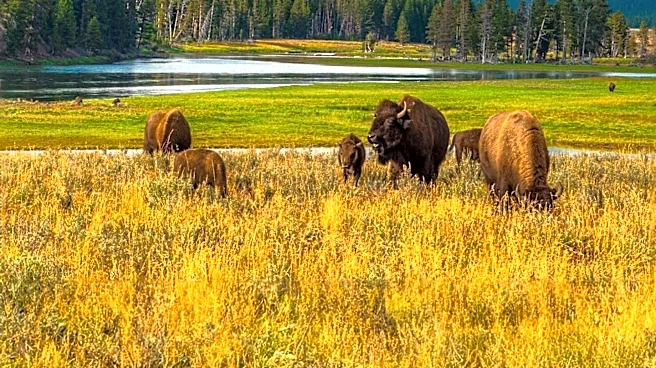
allows the American Prairie Foundation (APF) to continue grazing its bison on three federal grazing allotments in Phillips County. This action is part of an ongoing dispute regarding the use of federal lands for 'rewilded' conservation bison versus traditional livestock grazing. The American Prairie Foundation aims to establish a herd of 5,000 bison on 3.2 million acres of public and private land, believing this size is necessary for a healthy prairie ecosystem. The dispute escalated after the Bureau of Land Management (BLM) initially granted APF seven grazing allotments in July 2022. Governor Gianforte's administration argued that the BLM exceeded its authority and failed to assess economic impacts on local communities and concerns over bison containment. In January 2026, the BLM proposed revoking bison grazing permits, stating it lacked authority for non-production bison. After protests, the BLM's May 2026 decision terminated bison authorizations on six allotments but delayed effectiveness until September 30, 2026. APF then sued the BLM, leading to the September 4, 2026, district court ruling that partially granted APF's motion, allowing bison to remain on three allotments: Box Elder, Telegraph, and Whiterock Coulee.
Why It's Important?
This appeal is significant for Montana's agricultural industry and land management policies. Governor Gianforte and the state argue that the Taylor Grazing Act, Federal Land Policy and Management Act, and Public Rangelands Improvement Act authorize grazing permits exclusively for domestic livestock, not for non-production conservation bison. The state, along with local ranching families and organizations, contends that replacing production livestock with bison negatively impacts the local economy and disregards statutory requirements for federal grazing permits. The outcome of this appeal could set a precedent for how federal grazing lands are managed across the U.S., particularly concerning the balance between conservation efforts involving native species and traditional ranching operations. It highlights a broader conflict over land use, economic interests, and environmental goals in Western states. The decision will influence the future of bison reintroduction efforts on public lands and the economic viability of ranching communities that rely on these allotments.
What's Next?
The U.S. Court of Appeals for the Ninth Circuit will now review Montana's opening brief and hear arguments from both sides. The court's decision will determine whether the American Prairie Foundation can continue grazing bison on the three contested federal allotments or if the preliminary injunction will be reversed, requiring the removal of the bison. This legal battle is likely to continue, potentially involving further appeals depending on the Ninth Circuit's ruling. Stakeholders, including environmental groups, ranching associations, and state and federal land management agencies, will closely monitor the proceedings. The outcome could lead to policy adjustments at the federal level regarding grazing permits and conservation land use, potentially influencing similar disputes in other states. The American Prairie Foundation has expressed its commitment to keeping bison on the landscape, citing their ecological role and partnerships with Tribal entities, suggesting continued advocacy regardless of the court's decision.
Beyond the Headlines
This legal challenge delves into fundamental questions about the interpretation of federal land management laws and the evolving definition of 'grazing' on public lands. The state's argument that federal acts only authorize domestic livestock grazing raises a critical legal distinction between traditional agricultural use and ecological restoration. This case could force a re-evaluation of existing statutes to clarify whether native species like bison, even when managed for conservation, fall under the purview of these acts. Furthermore, it highlights the cultural and economic tensions between different visions for the American West: one rooted in traditional ranching and the other in rewilding and ecological restoration. The debate also touches upon the role of private foundations in influencing public land use and the extent to which state governments can assert control over federal land management decisions within their borders. The long-term implications could include legislative efforts to amend or clarify federal grazing laws to address the growing interest in bison reintroduction and other large-scale conservation projects.