




What's Happening?
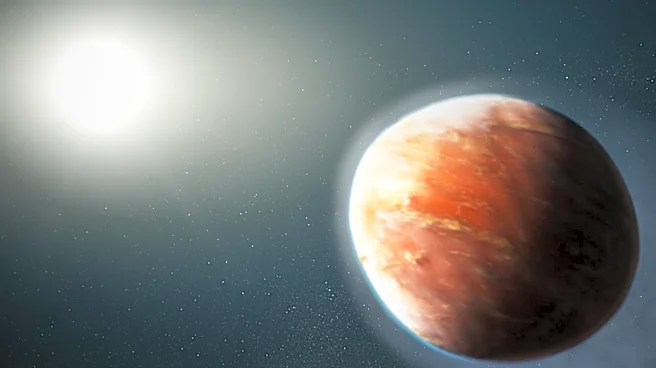
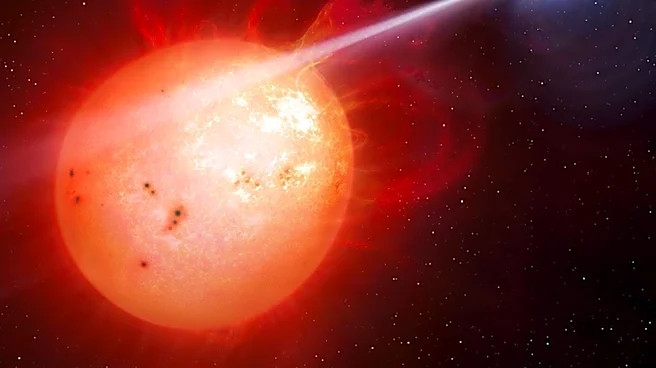
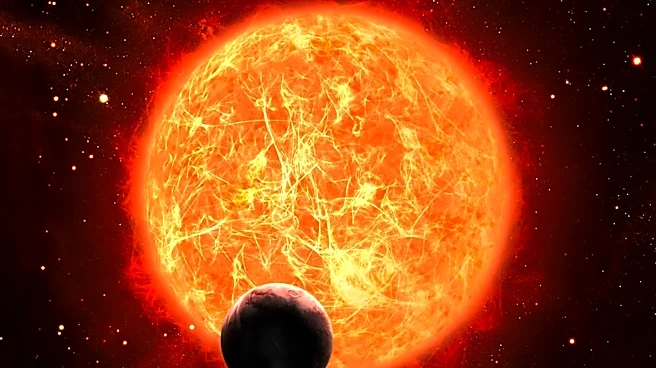
New simulations indicate that the giant planets in solar systems, including potentially Saturn, could be ejected from their orbits due to a phenomenon known as a 'white dwarf kick.' This kick is a small velocity a star gains as it transitions into a white dwarf,
estimated at about 0.75 km per second based on Gaia measurements of wide star pairs. The uneven loss of gas during this process nudges any orbiting planets. In 9 out of 10 simulations, the solar system's giant planets broke apart, with ejections being more common than collisions. One simulation showed Saturn being ejected within 2.5 million years of the white dwarf's formation, leading to these planets drifting through the galaxy as free-floating worlds. The model suggests that even the lower end of the measured kick range, 0.25 km per second, implies planets are already in a violent regime.
Why It's Important?
This research has significant implications for understanding the long-term stability and evolution of planetary systems, including our own. If giant planets can be ejected, it challenges previous assumptions about the permanence of planetary configurations around dying stars. For exoplanet research, it suggests that a substantial number of free-floating planets in the galaxy might originate from such ejections, rather than forming in isolation. This could alter our understanding of planetary demographics and the conditions under which planets survive stellar evolution. The findings also highlight the dynamic and potentially destructive nature of a star's final stages, impacting the habitability prospects of any remaining inner planets.
What's Next?
Future research will likely focus on refining these simulations to incorporate more complex astrophysical phenomena and a wider range of initial conditions. Scientists may also seek observational evidence of such ejected giant planets, which could be challenging given their free-floating nature. Further analysis of Gaia data could provide more precise measurements of white dwarf kicks, improving the accuracy of these models. Understanding the frequency and conditions under which these ejections occur will be crucial for developing a comprehensive picture of planetary system evolution and the ultimate fate of stars like our Sun.
Beyond the Headlines
The concept of planets being ejected into interstellar space raises profound questions about the prevalence of life in the universe. If planetary systems are routinely disrupted during stellar death, the window for life to persist could be significantly shorter than previously thought. It also opens up the possibility of 'rogue planets' carrying life between star systems, though the chances of such life surviving the harsh conditions of interstellar travel are extremely low. This phenomenon underscores the transient nature of cosmic structures and the continuous, often violent, reshaping of the galaxy, reminding us of the delicate balance that allows for stable planetary orbits and, by extension, the conditions for life.