







What's Happening?
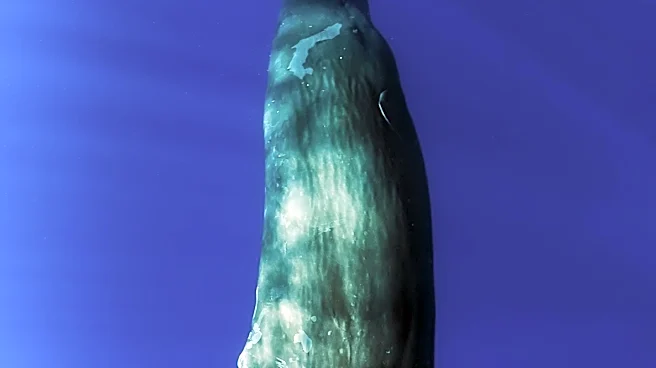
In 2020, scientists recorded a Cuvier's beaked whale dive lasting 3 hours and 42 minutes, the longest ever documented for any mammal. This dive, logged in a study by Duke University's Marine Laboratory and other collaborators, far exceeds the previously
calculated aerobic dive limit of 33 minutes for the species. The study, based on data from Cape Hatteras, North Carolina, challenges existing understanding of mammalian diving capabilities. Researchers found that the whale's dive duration significantly surpassed the previous record of 137.5 minutes set by the same species in 2014. The findings raise questions about the physiological adaptations that enable such extended dives.
Why It's Important?
This discovery pushes the boundaries of what is known about mammalian diving physiology, suggesting that Cuvier's beaked whales possess unique adaptations that allow them to exceed predicted limits. Understanding these adaptations could provide insights into the evolutionary biology of marine mammals and their ability to survive in extreme environments. The findings also highlight the need for further research into the physiological mechanisms that support such prolonged dives, which could have implications for conservation efforts and the study of marine ecosystems.
Beyond the Headlines
The study opens new avenues for exploring how marine mammals manage oxygen storage and metabolic rates during extended dives. It also raises questions about the potential impact of human activities, such as noise pollution, on the diving behavior of these whales. As researchers continue to investigate these phenomena, the findings could inform conservation strategies aimed at protecting marine mammals from environmental stressors. Additionally, the study underscores the importance of technological advancements in tracking and studying marine life, which can lead to groundbreaking discoveries about the natural world.