








What's Happening?
NASA has announced that the Artemis III mission, scheduled for 2027, will involve astronauts meeting two private spacecraft in Earth orbit. SpaceX and Blue Origin are both set to provide landers for this mission, which will serve as a precursor to Moon
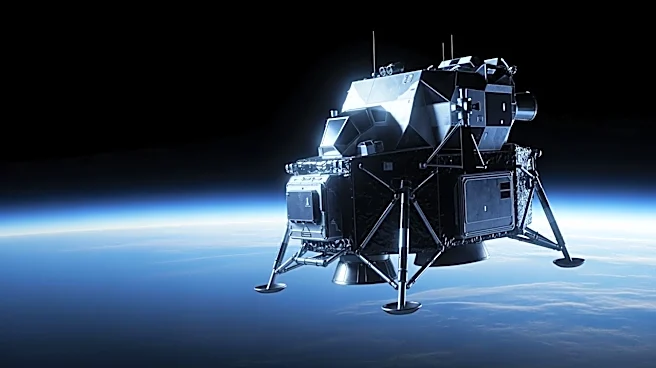
landings planned for the following year. John Couluris, Senior Vice President of Lunar Permanence at Blue Origin, expressed confidence in the readiness of their New Glenn rocket despite a recent explosion. The mission will see astronauts docking with Blue Origin's Mark 1 and SpaceX's Starship V3, with the Orion spacecraft facilitating these maneuvers. NASA aims for both landers to be ready for the Artemis IV Moon landing in 2028, with SpaceX's Starship slated for the trans-lunar injection. The Artemis III crew includes experienced astronauts such as NASA Commander Randy Bresnik and ESA Pilot Luca Parmitano.
Why It's Important?
The Artemis III mission represents a significant step in NASA's efforts to return humans to the Moon and establish a sustainable presence there. By involving private companies like SpaceX and Blue Origin, NASA is leveraging commercial innovation to advance its lunar exploration goals. This collaboration could accelerate the timeline for Moon landings and enhance the safety and efficiency of space missions. The mission's success could also bolster the U.S. position in the global space race, particularly against countries like China, which are also pursuing lunar exploration. Additionally, the involvement of private companies may lead to technological advancements and economic opportunities in the space industry.
What's Next?
Following the Artemis III mission, NASA plans to conduct the Artemis IV mission, which includes a Moon landing in 2028. SpaceX's Starship is expected to play a crucial role in this mission, performing the trans-lunar injection. The success of these missions could pave the way for more frequent and sustainable lunar exploration, potentially leading to the establishment of a lunar base. NASA's collaboration with private companies may also expand, potentially involving more commercial partners in future missions. The outcomes of these missions will likely influence NASA's long-term strategy for Mars exploration and other deep-space missions.