
What's Happening?
A recent study by researchers, including Sarah Thiele from Princeton, highlights the precarious state of satellite mega constellations in Low Earth Orbit (LEO). The study, published as a preprint on arXiv,
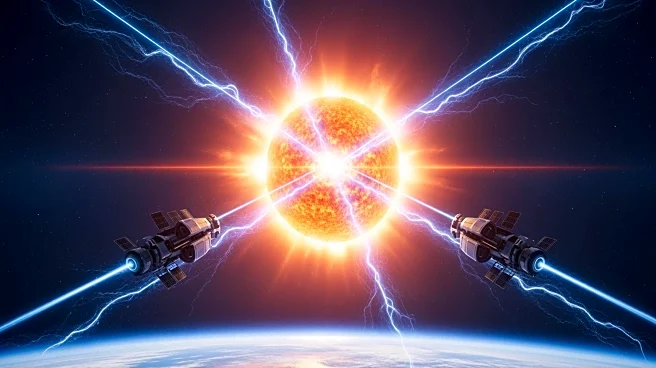
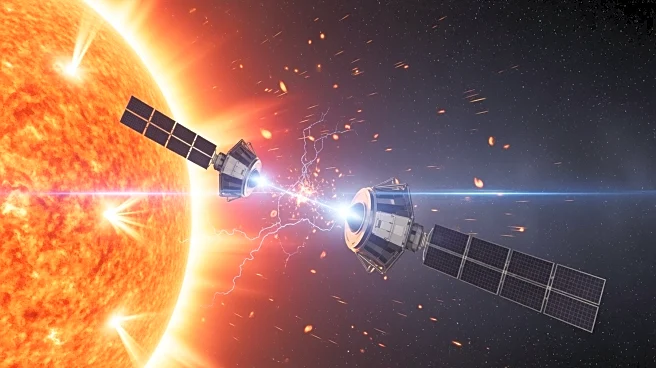
reveals that satellites in these constellations frequently come dangerously close to each other, with 'close approaches' occurring every 22 seconds. Within the Starlink network, this happens approximately every 11 minutes, necessitating frequent course corrections. The study emphasizes that solar storms pose a significant threat to these satellites by causing atmospheric heating, which increases drag and forces satellites to burn more fuel to maintain orbit. Additionally, solar storms can disrupt satellite navigation and communication systems, potentially leading to collisions. The researchers introduced the Collision Realization and Significant Harm (CRASH) Clock to measure the speed at which a crisis could unfold, estimating that a complete loss of control over satellite maneuvers could result in a catastrophic collision in just 2.8 days.
Why It's Important?
The findings underscore the vulnerability of satellite networks to solar storms, which could have severe implications for global communications and navigation systems. The potential for collisions could lead to the Kessler syndrome, where debris from collisions makes space launches nearly impossible. This scenario would not only disrupt current satellite operations but could also hinder future space exploration and technological advancements. The study highlights the need for improved monitoring and control systems to mitigate these risks. The economic and societal impacts of losing satellite functionality are significant, affecting industries reliant on satellite data, such as telecommunications, weather forecasting, and global positioning systems.
What's Next?
The study calls for urgent action to address the risks posed by solar storms to satellite mega constellations. This includes developing more robust systems for real-time monitoring and control of satellites during solar storms. The researchers suggest that operators need to be prepared for rapid response to minimize the risk of collisions. Additionally, there may be a need for international collaboration to establish guidelines and protocols for managing satellite traffic in LEO to prevent potential disasters. The study also highlights the importance of continued research into the effects of solar storms on satellite operations to better predict and mitigate their impacts.
Beyond the Headlines
The research raises ethical and strategic questions about the deployment of large satellite constellations without fully understanding the long-term risks. The potential for a single solar storm to disrupt global satellite infrastructure highlights the need for a balanced approach to technological advancement and risk management. The study also points to the broader implications of space debris and the sustainability of space activities, prompting discussions on international regulations and cooperation in space governance.