
What's Happening?
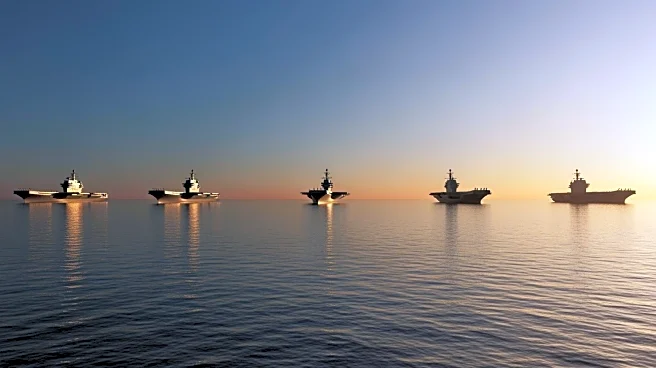
The Pentagon has reported that China plans to construct six additional aircraft carriers over the next ten years as part of its efforts to enhance its naval capabilities. This development is part of China's
broader strategy to build 'world-class' armed forces by 2049. Currently, China possesses the world's largest navy by hull count, with over 370 vessels, including three aircraft carriers. However, it still lags behind the United States, which has 11 aircraft carriers. The Pentagon's report indicates that China aims to have nine aircraft carriers by 2035, including the CNS Liaoning, CNS Shandong, and CNS Fujian, which was commissioned in November. The report highlights China's military modernization efforts and its ambition to challenge U.S. military presence in the western Pacific.
Why It's Important?
China's plan to expand its aircraft carrier fleet is significant as it underscores the country's intent to project power beyond its coastline and challenge U.S. military dominance in the region. Aircraft carriers are crucial for a nation's military strength, serving as mobile air bases that can influence regional and global power dynamics. The expansion of China's carrier fleet could alter the balance of power in the Asia-Pacific region, potentially leading to increased tensions with the United States and its allies. This development also reflects China's broader geopolitical ambitions and its desire to assert itself as a leading global military power.
What's Next?
The future of China's aircraft carrier development remains uncertain, as it is unclear whether all planned vessels will be operational by 2035. The construction of these carriers will likely involve significant resources and technological advancements. The U.S. and its allies may respond by enhancing their own military capabilities in the region to counterbalance China's growing naval power. Additionally, diplomatic efforts may intensify to address the potential for increased military tensions in the Asia-Pacific.