

What's Happening?
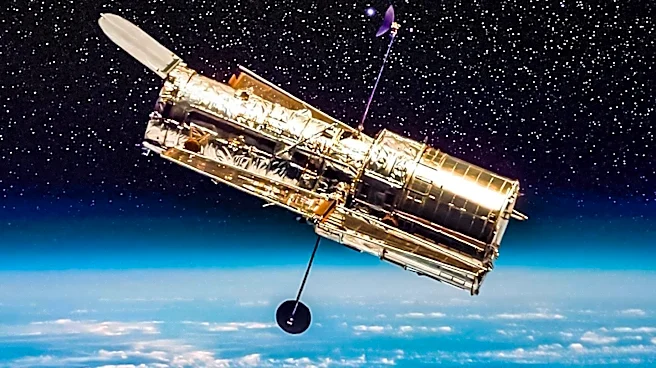
Astronomers utilizing the NASA/ESA Hubble Space Telescope have reported the discovery of a new ten-sided wave, or decagon, encircling Saturn's south pole. This massive storm measures approximately 104,000 miles across, with each straight side extending
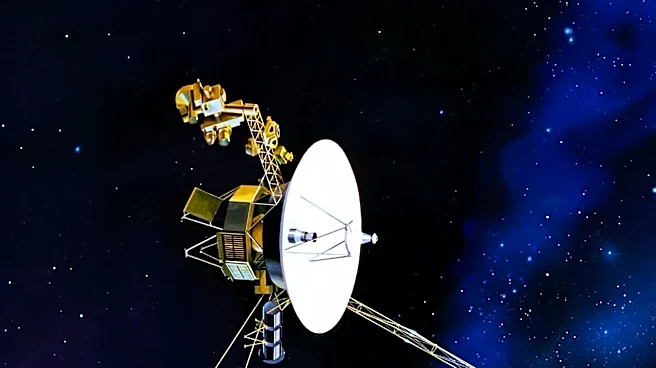
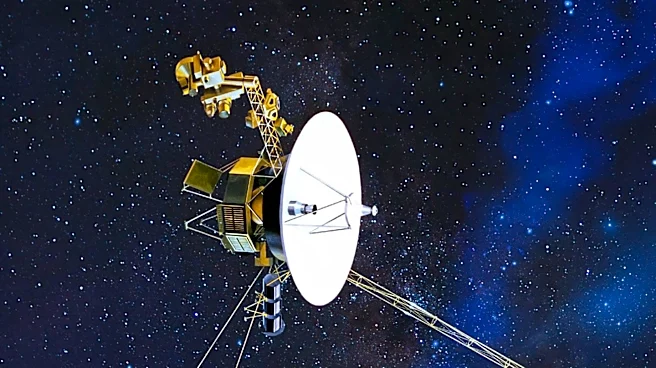
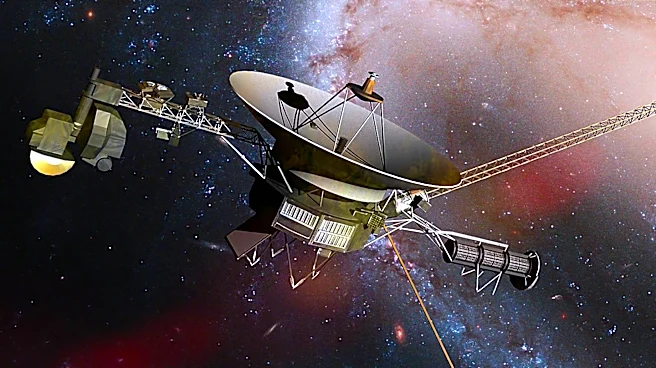
about 10,000 miles. This decagon is considered a geometric counterpart to the well-known six-sided jet, or hexagon, that has been observed around Saturn's north pole for over four decades since its initial sighting by Voyager. The finding, detailed in a paper published in Science Advances, was led by Agustín Sánchez-Lavega of the University of the Basque Country, with contributions from Amy Simon of NASA's Goddard Space Flight Center and Mike Wong of the University of California, Berkeley. The south pole's axial tilt and long orbit meant it was out of useful view from Earth between roughly 2012 and 2023, which is why this feature was not observed earlier. The Cassini mission, which orbited Saturn from 2004 to 2017, had previously recorded a warm polar vortex and a cyclone at the south pole but no persistent polygonal jet. The decagon was faintly present in Hubble imagery from 2023 and has become more pronounced in subsequent years.
Why It's Important?
The discovery of a second polygonal storm on Saturn, mirroring the long-standing northern hexagon, significantly impacts our understanding of planetary atmospheric dynamics. For decades, the northern hexagon was considered a unique anomaly of Saturn. The presence of a decagon at the south pole suggests that the formation of such geometric patterns is a more fundamental characteristic of Saturn's atmosphere under specific conditions, rather than a singular event. This finding challenges existing numerical models of Saturn's jets, which will now need to account for the simultaneous existence of both a hexagon and a decagon in opposite hemispheres. The differing number of sides (six versus ten) indicates distinct configurations in the southern and northern jets, relating to the width, speed, and shear of the circumpolar flows. This research provides crucial data for refining atmospheric models and understanding the underlying physics of large-scale weather phenomena on gas giants, potentially offering insights into similar processes on other planets or even Earth's own atmospheric complexities.
What's Next?
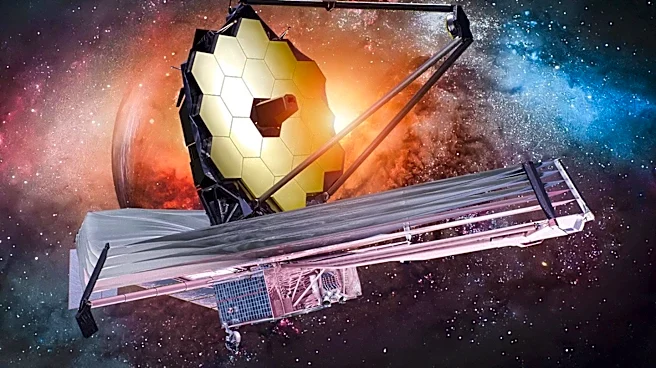
Continued monitoring by the Hubble Space Telescope is crucial to track the evolution of the decagon, observing whether its sides sharpen or blur and if the entire pattern drifts in longitude. The James Webb Space Telescope will also play a vital role, using its infrared capabilities to probe the temperature and deeper structure of the storm, determining how far down into Saturn's atmosphere the feature extends. Researchers will also investigate why this pattern emerged in the 2020s, given that earlier observations by the Cassini mission did not detect it. Key questions remain regarding whether the decagon is seasonal, linked to Saturn's 29-year orbit and the slow swing of sunlight across its poles, or if it will settle into a long-term permanence similar to the northern hexagon. The data collected will be essential for developing more accurate numerical models of Saturn's jets, aiming to reproduce both the hexagon and the decagon simultaneously, thereby advancing our understanding of planetary atmospheric physics.
Beyond the Headlines
The existence of two distinct polygonal storms on Saturn's poles, a hexagon and a decagon, opens up deeper questions about the fundamental principles governing fluid dynamics in extreme environments. Laboratory experiments with spinning fluids have successfully produced similar polygonal shapes, suggesting that these phenomena are rooted in universal physical laws related to instabilities in strong circumpolar flows. This discovery moves beyond simply observing a celestial curiosity; it provides a natural laboratory for studying complex fluid dynamics on a planetary scale, which is difficult to replicate on Earth. Understanding how these stable, long-lived geometric patterns form and persist in Saturn's atmosphere could have implications for theoretical physics, meteorology, and even the study of other exoplanets. It highlights the intricate and often unexpected ways in which physical forces manifest in the cosmos, pushing the boundaries of our current scientific understanding and encouraging a re-evaluation of what we consider 'normal' atmospheric behavior on gas giants.