





What's Happening?
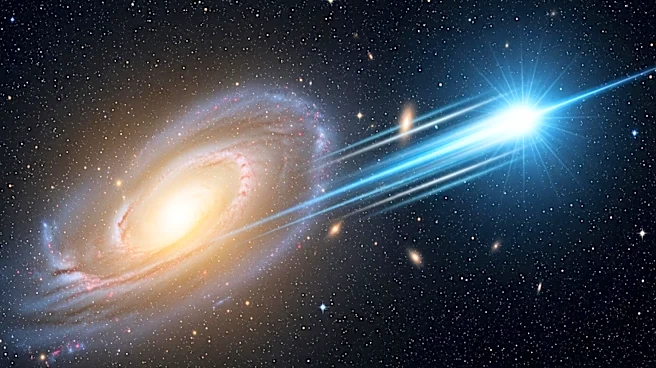
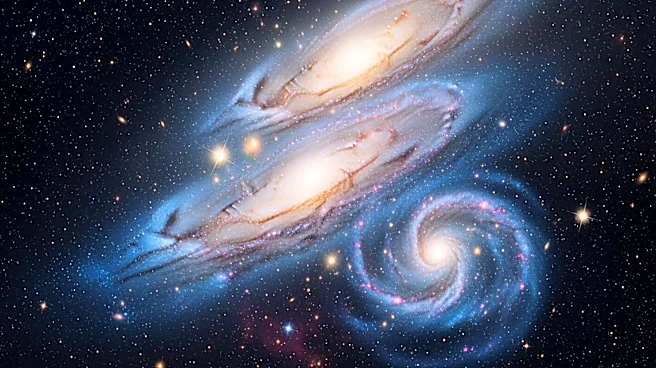
A new study has reignited the debate over whether the Large Magellanic Cloud (LMC) is making its first or second pass by the Milky Way. Researchers, led by Scott Lucchini and colleagues, have presented evidence suggesting this is the LMC's first encounter
with our galaxy. Using hydrodynamic simulations, they compared the LMC's current position and velocity with observational data, concluding that a first-pass model aligns better with the observed characteristics. This finding challenges previous theories that suggested a second pass, which were based on different interpretations of the LMC's trajectory and interactions with the Milky Way's dark matter halo.
Why It's Important?
Understanding the LMC's trajectory is crucial for astrophysics as it impacts our knowledge of galactic evolution and dynamics. The LMC's interaction with the Milky Way can influence star formation rates, galactic structure, and the distribution of dark matter. If the LMC is indeed on its first pass, it could mean that our understanding of the Milky Way's gravitational influence and its halo's properties needs revisiting. This research could lead to new insights into the formation and evolution of galaxies, affecting models used to predict cosmic phenomena.
What's Next?
The debate over the LMC's trajectory is likely to continue as more data becomes available. Upcoming missions, such as NASA's Aspera mission, may provide more detailed observations of the Magellanic Clouds and their interactions with the Milky Way. These findings could either confirm the first-pass theory or provide new evidence supporting a second pass. Continued research and collaboration among astrophysicists will be essential to resolve this debate and enhance our understanding of galactic dynamics.