





What's Happening?
A recent study led by Sarah Thiele from Princeton University, published on arXiv, highlights the fragility of satellite operations in low Earth orbit. The research introduces the Collision Realization And Significant Harm (CRASH) Clock, which estimates
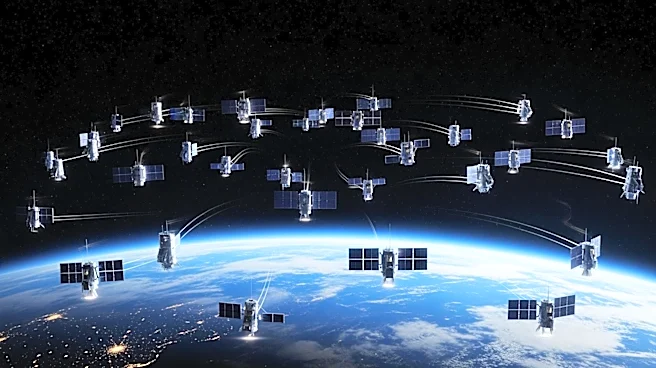
that a major collision could occur in as little as 2.8 days if satellite operators lose the ability to coordinate or maneuver spacecraft. The study emphasizes the increased risk due to the growing density of satellites and debris, particularly with the expansion of mega-constellations like Starlink. These networks have transformed low Earth orbit into a congested area, requiring constant collision avoidance maneuvers. The study also points out that solar storms pose a significant threat by disrupting satellite tracking and communication systems, potentially leading to a rapid breakdown in orbital safety.
Why It's Important?
The findings of this study are crucial as they underscore the vulnerability of the satellite infrastructure that supports global communications, navigation, and weather forecasting. The increased density of satellites and debris in low Earth orbit heightens the risk of collisions, which could have cascading effects, potentially leading to the Kessler Syndrome—a scenario where space becomes unusable due to a chain reaction of collisions. This situation poses a significant threat to industries reliant on satellite technology, including telecommunications, defense, and meteorology. The study calls for improved management and coordination of satellite operations to prevent catastrophic collisions and maintain the integrity of space-based services.
What's Next?
The study suggests that immediate action is needed to enhance the coordination and maneuvering capabilities of satellites to prevent potential collisions. This includes developing more robust systems to withstand solar storms and other disruptions. Stakeholders in the satellite industry, including companies like SpaceX and government agencies, may need to collaborate on establishing new protocols and technologies to manage the increasing congestion in low Earth orbit. Additionally, international cooperation could be essential in addressing the global nature of satellite operations and ensuring the long-term sustainability of space activities.