






What's Happening?
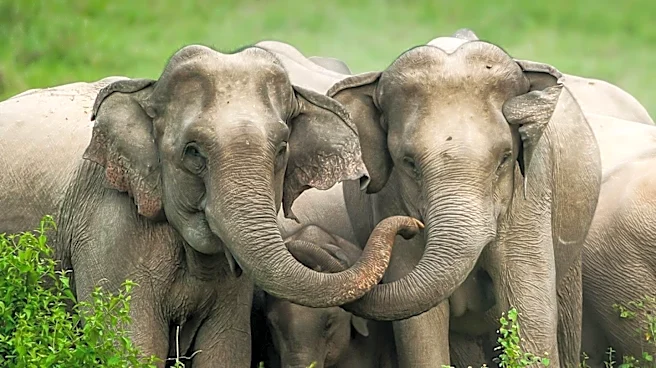
A long-term study of wild Asian elephants in Sri Lanka, conducted by Anastasia Madsen and Shermin de Silva of the University of California, San Diego, reveals that elephant social networks are fracturing due to environmental pressures. Analyzing 12 years
of observations, researchers found that as losses in the elephant population began to outpace newcomers, the elephants' social structure didn't just shrink but became fragmented. This fracturing is linked to the disappearance of grass and the takeover of invasive plants in Udawalawe National Park, leading to increased competition for food. Female elephants, which typically live in complex fission-fusion societies, are showing smaller and less-connected social groupings, a phenomenon that researchers warn could be an early indicator of impending population collapse.
Why It's Important?
This research offers critical insights into the resilience limits of animal communities and has significant implications for wildlife conservation efforts globally, including those in the U.S. The observation of 'flickering' in network statistics—where social connections fluctuate before a collapse—could serve as an early warning system for conservationists. By detecting these subtle changes in social structures, park managers and conservationists could intervene before a population reaches a critical decline. For U.S. wildlife management, particularly for species facing habitat loss or environmental degradation, understanding these social dynamics could lead to more proactive and effective conservation strategies, moving beyond simple population counts to assess the health and stability of animal societies.
What's Next?
The study suggests that monitoring social network dynamics could become a crucial tool for conservation. Researchers hope that park managers and conservationists can use signals like 'flickering' in social network statistics to detect impending population collapses and intervene proactively. This could involve habitat restoration, managing invasive species, or implementing measures to reduce competition for resources. For U.S. conservation agencies, this implies a potential shift towards incorporating social network analysis into wildlife monitoring programs, particularly for endangered or vulnerable species. The focus would be on understanding not just population numbers, but also the health and connectivity of social groups to ensure long-term species survival.
Beyond the Headlines
The fracturing of elephant social networks due to environmental stress highlights a broader ecological principle: the interconnectedness of habitat health and social resilience in animal populations. The study underscores how human-induced environmental changes, such as habitat alteration and resource scarcity, can have profound and often subtle impacts on animal behavior and social structures. This goes beyond immediate threats like poaching, pointing to the long-term, cumulative effects of environmental degradation. The concept of 'flickering' as an early warning sign could be applied to other complex biological systems, offering a novel approach to predicting ecological tipping points and informing conservation strategies that address the holistic well-being of species, not just their numbers.