







What's Happening?
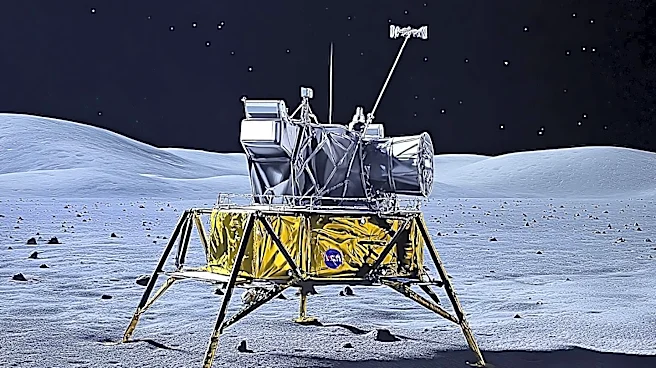
A national committee of experts, co-chaired by Scripps Oceanography geologist James Day, has issued an independent report commissioned by NASA. This report recommends four potential crewed lunar mission locations beyond the moon's south pole, advocating
for a global exploration strategy. The proposed sites aim to address a wide range of scientific questions and assess the feasibility of establishing lunar bases for future space exploration. The recommended locations include the far side of the moon for studying the early universe, the lunar limb for investigating the moon's formation and collecting geological samples, an Apollo landing site on the near side to study changes over time, and a volcanic plateau on the near side to research volcanic rocks and 'living off the land.' This initiative comes as NASA plans to land astronauts on the lunar surface for the first time since Apollo 17, nearly 54 years ago, following the recent crewed lunar flyby by Artemis II.
Why It's Important?
This report is crucial for shaping the future direction of U.S. space exploration, particularly NASA's Artemis program. By advocating for diverse landing sites, it broadens the scientific scope of lunar missions beyond the previously emphasized south pole, which is primarily valued for its water ice deposits. Exploring various geological and environmental contexts on the moon will provide invaluable data for understanding the moon's origin, the history of the solar system, and the potential for resource extraction. This diversified approach could accelerate the development of technologies and strategies for long-duration human presence in space, including the establishment of lunar bases and future missions to Mars. The insights gained from these varied missions will be vital for ensuring the safety and sustainability of human spaceflight, impacting everything from life support systems to resource utilization and the long-term viability of off-Earth settlements.
What's Next?
NASA will likely consider the recommendations outlined in this report as it finalizes plans for upcoming crewed lunar missions. The agency will need to evaluate the scientific priorities, logistical challenges, and safety considerations associated with each proposed landing site. Further research and technological development will be required to prepare for missions to these diverse locations, especially those with unique environmental conditions like the far side of the moon. The report also emphasizes the need to learn how to operate safely in space and responsibly utilize lunar resources, suggesting that future missions will focus on developing sustainable practices. This will involve continued collaboration between scientists, engineers, and policymakers to translate these recommendations into actionable mission plans and ensure the long-term success of human space exploration.
Beyond the Headlines
The report's emphasis on exploring diverse lunar sites and responsibly utilizing resources highlights a deeper shift in space exploration philosophy. It moves beyond a singular focus on immediate resource acquisition (like water ice) to a more holistic approach that prioritizes scientific understanding, long-term sustainability, and the ethical implications of extraterrestrial activities. The concept of 'space archaeology' at Apollo landing sites underscores the historical and cultural significance of human endeavors in space. Furthermore, the discussion of extracting precious metals like platinum and palladium from the moon, while advocating for responsible practices, opens up complex ethical and legal questions regarding lunar ownership, resource governance, and environmental preservation in space. This broader perspective is essential for establishing a framework that ensures space exploration benefits all of humanity while safeguarding celestial bodies for future generations.