






What's Happening?
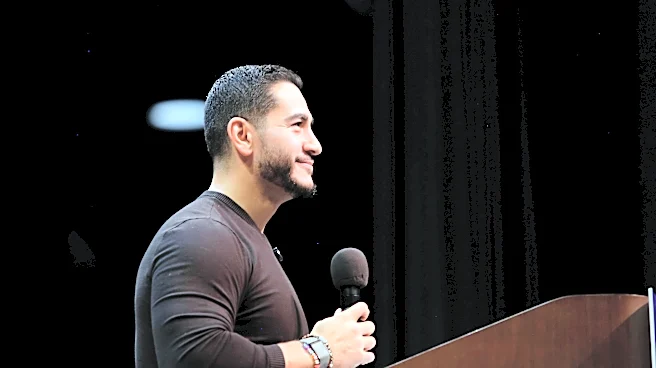
Ana Navarro, a prominent journalist and panelist, has publicly criticized Mike Rogers for his silence during racist and Islamophobic attacks directed at Abdul El-Sayed. Speaking on her podcast, Navarro asserted that Rogers had 'lost his moral compass'
by not intervening or speaking out against the discriminatory remarks. She drew a parallel between Rogers' inaction and Senator John McCain's defense of then-candidate Barack Obama during the 2008 presidential campaign, highlighting what she perceives as a decline in political integrity. Navarro emphasized that the pursuit of electoral victory should not come at the cost of one's moral principles, stating, 'Winning an election is not worth losing your soul.' This critique underscores a broader concern about the normalization of hateful rhetoric in political discourse and the responsibility of public figures to condemn such behavior.
Why It's Important?
Navarro's comments are significant as they highlight the ongoing debate within U.S. politics regarding the ethical responsibilities of public figures, particularly in the face of discriminatory attacks. Her comparison to John McCain's actions in 2008 serves as a reminder of past political norms where bipartisan condemnation of racism was more common. This incident brings to the forefront the question of whether political ambition is increasingly overshadowing moral obligations to speak out against prejudice. For civil society groups and advocates for minority rights, Navarro's stance validates their concerns about the impact of silence from influential figures. It also puts pressure on other political leaders to consider their own responses to similar situations, potentially influencing future political discourse and the willingness of individuals to challenge hateful rhetoric.
Beyond the Headlines
The critique by Ana Navarro extends beyond a simple political disagreement, touching upon deeper ethical and societal implications. It raises questions about the erosion of moral leadership in public life and the potential long-term consequences for democratic values. When public figures remain silent in the face of racism or Islamophobia, it can be interpreted as tacit approval, thereby normalizing such behavior and making it more acceptable in broader society. This can have a chilling effect on minority communities, who may feel increasingly marginalized and unprotected. Navarro's call for politicians to prioritize their 'soul' over electoral wins suggests a yearning for a return to a more principled form of politics, where integrity and moral courage are valued as much as, if not more than, strategic political gains. This sentiment reflects a growing concern among some segments of the public about the moral direction of the nation's political landscape.